Shortly after Osama bin Laden was killed, Rush Limbaugh apparently was talking up a storm because he said on his show that with three wives, you'd think Osama's house would have been a little neater.
I really don't want to debate whether that comment was offensive to women or not, because that's not where I'm going with this, though if you'd like to comment on it, you're more than welcome. I don't listen to Rush; don't get him on my radio up here in Canada. But I saw a link to this transcript, and I thought this was interesting:
Folks, it was a pigsty. I'm not trying to offend Muslim sensibilities here. Pigsty's been around long before I was aware that that had some sort of possible problem with Muslims. I mean, for crying out loud, dirty windows, half eaten food on the floor, filthy clothes shoved under the unmade bed. I mean it looked worse than a teenage kids room. It looked like a crack house. And they continue with this business here that it was some million-dollar property.
Then he says:
Here's a guy with three wives living in a pigsty. One ought to be enough to keep it clean.
So, what's up?
First, a simple observation. Polygamy is absolutely, completely, undeniably disgusting. I can't think of a worse type of relationship. You are property; you aren't loved. That's not even marriage. A marriage is between one man and one woman, and it is exclusive. Polygamy is a debased distortion of what God intended (and God even warned Solomon about it).
And think of what polygamy does: it tells women that you're not really special. You're here to perform a role, which is basically a sexual one. You're not here to be a confidante or a friend, because I can't treat you any differently from any of the other wives. So I'm just going to use you.
No wonder depression is so high in the Muslim world!
If you were one of Osama's 3 wives, would you clean anything? I don't think I would, because nothing would really be mine. Everything would be his, and if I made it better, then I'd be making life better for two of my rivals and all of their children, too. So there would be a race to the bottom, I believe; a race to see who can get away with doing the least, so that nobody else benefits from our labour. And Osama, of course, would never clean because it was beneath him. So they all lived in squalor, despite the fact that he was supposed to be so revered. His life was disgusting, his end was pathetic, and he poisoned everything he touched.
Socialism has a similar problem as Osama's lack of housekeeping, by the way. When everything is owned in common, then people don't care for it properly, because others can abuse it or can skate along with no effort on their own part. That's one reason, for instance, that agricultural output in the former Soviet Union kept decreasing every year, despite all the new agricultural policies. When people don't own the crops they produce, and when others can benefit from their own work, then people will not work as hard.
Ownership matters. If we're going to have pride in something, we have to have a stake in it which cannot be taken away. We have to be able to benefit from the fruits of our labour, but, just as importantly, we have to be able to benefit ONLY from the fruits of our labour. If we can get something for free, why work for it? But if we do work, and then we can enjoy the rewards, we will.
So let's bring this back around to us. Do you take pride in your home? I did a whole lot more when we bought our house than when we rented. For the first seven years of our marriage we were in rental housing, and it's hard to get excited about a place you know isn't really yours. We could never paint any colour other than beige, and we couldn't put much up on the walls. We couldn't change the kitchen cabinets or fix them up. And why would we put work into a place we weren't going to stay in?
But as soon as we moved, I started buying decorating books and gardening books and everything, because I wanted to make a nice place for my family.
It's funny, but I used to think I was a bad housekeeper. Looking back, I think it was more that I was just a pragmatic renter, and it was hard to get excited about beautifying a place that wasn't mine. That's not an excuse to keep things messy, by the way; I'm just saying that I got much more excited about cleaning once it was my house.
The other big difference is that when you're renting, you tend to live in a smaller place than you would otherwise. You're giving your money away to a stranger every month, so you tend to live more frugally, saving up money so you can invest in something that's really yours later. For us, that meant we never had enough storage space when we were renting. We never had enough rooms, or enough closets, or enough wall space for bookcases for all our stuff. And it's much harder to keep the house neat when there just isn't room for everything.
The moral to this story? Don't be too hard on yourself if you're living somewhere that isn't really yours. Do the best you can, but realize that comparing yourself to someone who owns their own home isn't the same. And save some money, so that one day, when housing prices finally do settle down to a reasonable level, you'll be able to actually own something.
Oh, and don't become Muslim. Polygamy doesn't work for so many reasons, but one is that nothing is ever really yours--even your husband.
I received a book to review on this blog a few months ago that I was actually pretty excited about. It was talking about entertaining for people who didn't really like to entertain or didn't feel like they knew how. And I thought, that's for me! I'm not a detail person. I find it hard to put on a party, because when people come I get so caught up in talking to them I forget about little things like oven timers and when food has to be turned on.
So I thought: this can help organize me!
Instead it just depressed me. It was all about how to make your home beautiful, and how to do gorgeous place settings, and how to make canapes. I'm never going to make canapes.
Now maybe you have the gift of entertaining, and you find this sort of thing fun. But what I find fun is having a pile of people over, serving something easy like chicken fajitas with lots of fixings, and then eating wherever you can find a chair while you talk nonstop, and then playing board games afterwards while the kids scatter.
In fact, after reading this book, I began to think that maybe I'd never actually thrown a dinner party in my life! I've had tons of people over for dinner, but I've never thrown a dinner party! I've only ever "had people over". I had thought I had thrown dinner parties, but my table never looked anything like the tables in that book.
Please understand; I am not saying there's anything wrong with that kind of entertaining. But I just don't know if I have the time to put in that kind of work in order to have people over. The author of this book gets her kids involved, and it's a family affair, and that's wonderful. But I'm not that kind of person. I'm a lot more laid back. I like a lot of laughter, not quiet music playing in the background. I like big debates, not tame conversation. So I'm not a dinner party gal.
I worry that if we expect that anytime we have people over for dinner it has to be a big production, that we will stop inviting people over. One of the best things you can do to encourage friendships for your children (and yourself) is to have people over. Invite other families over. Talk. Instead of watching TV tonight, talk to friends! Share food. Have people bring something and contribute. Let's function more like a community.
But will we do that if we think that we must have elaborate place settings for people? Or we must plan a menu to reflect the seasons, or the fall colours, or the summer bounty? What if I just want to clear out my freezer?
I'm not saying I don't put any effort in; I guess it's just that I see a difference between hospitality and entertaining. Hospitality says, "come and share my life". Entertaining says, "I will do something out of the ordinary and extraordinary for you". Hospitality says, "I'm not really making extra effort; I just value you and so I want to include you in what we're doing because you make it better by being here." Entertaining says, "I went out of my way for you."
One isn't wrong and one right, it's just a different philosophy. I would rather just share my life, and so I don't do the whole "posh" thing. But some people are very good at posh, and it comes naturally. So by all means, go ahead!
But let's not think that in order to have people over we have to be posh. No, you don't. Do you know how rare a home cooked meal is today, even if it's just spaghetti? Anything you do is probably impressive. So don't be afraid to share, even the little you do have. Remember the five small barley loaves and two small fish? They weren't much, but they fed a ton of people and everyone had a big party. You can take the little you have and give people a memory.
I figure that what people remember is the feeling of community and the interaction. Others who focus more on entertaining may feel they remember the beauty, and the grace, and the effort. Both are fine. But that beauty and grace and effort, while lovely, is not necessary. Don't let fears that you can't entertain stop you from having people in. Just share who you are, and laugh, and talk, and play, and have fun, and people will remember, even if it's not a traditional dinner party. And if we all got back to inviting people in once a week, rather than hibernating in our own homes watching TV, we'd be a much healthier society.
Do you have people over? What's your favourite thing to make? How do you make it fun? Let me know!
My blogging buddy Terry posted recently on some of her new homeschooling escapades--she's new to the homeschooling world--and part of what she's doing is educating herself. She writes:
I’ve been learning some things too and I’m pretty excited about it since they’re things I never envisioned myself learning to do. I changed the oil in our Suburban this past weekend. If that doesn’t impress, I also changed the brakes! If my husband hadn’t hurt his wrist recently, I probably never would’ve taken the time to learn how to do such a thing, but I’m glad I did. The older I get, the more I appreciate how important it is for women as well as men to be well-rounded and equipped to handle whatever the task at hand may be, rather than tagging every chore as “men’s work” or “women’s work.” We saved our family some of the money my husband works hard to earn with my willingness to step outside my comfort zone and do what needed to be done. Now that I’m done bragging on my awesome womanliness....
(I don't know why I left an incomplete sentence in there (the rest of the sentence isn't relevant for my purposes here), but I just like it. :)
So here are my true confessions: I'm scared to check the oil, let alone change it. Air machines, where you fill up tires, scare me, too. I can't figure out how to do it without getting dirty. And what if I put too much in? What if I can't figure out when it's actually full? I don't actually think I know how to lift the trunk on my car. I just travel with CAA Plus (the equivalent of AAA), and a cell phone.
My husband has showed me how to check the air on my tires countless times, but I still can't do it.
We have a tent trailer that we use to go camping with, and about four years ago a friend and I decided to go camping without the men, who needed to work. Do you think we could get that stupid dining tent up? My friend Susan is much less wimpy than I am, but even there we had major trouble. Her husband showed up and got the thing erected in three minutes flat.
Now, it's not that I'm a princess. I'm really not. I don't mind hard work. I like to exercise. My nails aren't done. It's just that figuring out how to put things together or how to make things work scares me.
I'm not proud of it. I felt horrible that week that we were camping and we couldn't seem to fix stuff. You're helpless. And I've realized that if something happened to Keith, I'd have to quit camping. I've tried to have him teach me how to put the thing up before, but I just don't seem to have the strength or coordination. I'm even scared to drive the van when it's pulling the trailer!
So I'm very proud of Terry for changing the oil and stepping outside of her comfort zone! I totally believe that women should know how to do these things. I just don't want me to be next. You all can go next. I'll continue to wait on the sidelines.
I'm not like this in other areas of my life. For instance, I think it's absolutely ridiculous and dangerous to not know anything about the family's finances. All women need to know how much money the family has, what the net worth is, where the insurance is (and what you have insurance for), how much coverage you have, where your investments are, etc., even if you're not the one to look after them. I've known women who were left by their husbands who were swindled out of tons of money because they didn't know they had it.
I've known others who had their husbands suddenly fall ill who didn't know how to look after any of the bills.
I'm good at all that stuff. I used to take care of it (Keith took over about three years ago), but I could step in again if I had to.
I just still can't top up the air in the tires. Or change the oil. Or change a tire.
I know in most homes cleaning is a major source of conflict--or at least frustration. There's a never-ending list of things that need to be cleaned, and yet there seems to be a shortage of those who are willing to pitch in. In fact, most moms find themselves cleaning alone, and when we do get others to help, it's often more trouble and frustration than it's worth.
Many Saturday mornings when the children were younger I remember getting all excited about carrying out my chore plan. The kids knew what to expect, we all knew what was on our lists, I put on music, and we got to it.
Or at least I got to it. I cleaned, and the girls bickered. They fought more when doing chores than they ever did at any other time--even though they weren't doing the SAME chores. Rebecca would get mad if she thought she was putting in more effort than Katie. Katie would get mad if she felt that Rebecca was telling her what to do. And I would yell and threaten and tell them nobody was getting their allowance if they're going to make my life even more miserable!
We're over that stage now, and I've learned that getting involved in their emotional squabbles aren't worth it for me. It just makes me mad, and it doesn't actually get anything done. Waltzing in and saying in a sing song voice, "Looks like nobody's getting allowance unless you both leave each other alone in the next two minutes and finish your chores", and then waltzing back out, works much better. Sometimes I've had to follow through and not given an allowance, and then they're in a lot of trouble. I won't drive them somewhere they want to go that week, because they made my life miserable. And slowly but surely they've stopped bickering.
But it's not easy. And often chore systems get complicated not because the system itself is hard, but because we let our emotions get involved, and we get wrapped up in the mind games they're playing. So here are several tips on how to recruit help for chores, and maintain your sanity in the process!
1. Accept the fact that you care about the house more than other people do.
Many kids don’t care if the house is a mess and if the only meals cooked are Kraft Dinner. Lots of husbands may not notice a dust bunny until it impedes their view of the television. So we don’t share values when it comes to keeping the house clean.
But that doesn’t mean that we can’t work towards everybody pitching in. The key is just to realize that they’re not going to do it automatically, because they don’t share the commitment to it. Expecting others to want to do it is to set yourself up for major disappointment.
Approach it another way, though—that nobody really likes doing this, but it’s something that needs to get done—and you can make a difference.
2. Talk about chores as if they're everyone's job
Start with the idea that they’re not “helping” you if they clean; it’s everybody’s job to clean, not just yours. And then just talk about what a fair division of labour is. Of course, different family members require different strategies (you have no authority over your husband, for instance), but you can make a difference, once you stop doing everything and start leaving room for others to help!
3. Stop doing everything
They’re also not going to start pitching in if you keep doing everything. Don’t clean and then fume that no one’s mopping with you. You need to stop some of what you’re doing before others pick up the slack.
4. Find a chore system that works for you
When my daughters were small, we put stickers on the fridge when they did their chores. Since they’ve been five we’ve paid them an allowance, and that’s worked well. When they were small, I also did the chore with them or checked up right then. Now we use a checklist and I expect it all done by Saturday night.
You just have to find a system that works for you. People could choose their favourite chores, and stick to those, or you could put chores on pieces of paper and stick them in a basket, and everyone “chooses” their chores for that week. Or you could rotate. It really needs to be something that works for your family. One suggestion, though: make sure every child knows how to do every chore, even if they don’t do them very often. One day, when they have their own household, they’ll have to do it, so this is part of their training for independence.
The main thing, though, is to be consistent. If you want the chores done by Saturday night, enforce that rule. If you are giving an allowance, actually give it out. Don't forget, or it loses its appeal. And if you're tying chores to allowance, then stop buying them chocolate bars everytime you're out. Make them have a reason to want to earn their own money!
5. Reward cleaning, not attitude
Disrespect is obviously not tolerated. But if a child is dawdling, and cleaning as slowly as possible, is this really worth getting into a fight over? After all, they're going to have to finish the chore before they can go do something they want to do. If they decide to be slower than molasses, they're only hurting themselves.
My suggestion? Ignore behaviour like that. Tell them firmly but happily that they have to get it done, and then leave them alone. Don't start fighting about attitude, because then you end up arguing about intangibles, and you can't win. You start arguing about whether or not someone's really trying, and they insist they are, and then where do you go? They start crying, you try not to yell, and it's ugly all around.
You require the cleaning to get done. That's non-negotiable. If they want to flop on the floor every now and then, or work slowly, or scowl, then leave the room so you can't see them.
If they start fighting with siblings, as mine often do, I just tell them that they're not allowed to make my life miserable and start taking away allowances. Or I just make sure that they're cleaning on two different floors of the house.
6. Negotiate in good faith with your husband
If your husband is just not interested in cleaning, I don’t think this is worth getting into a huge fight about, personally. What’s more important to me is that the man spend some time with the children, not necessarily that he mop everything in sight. Everyone should be doing some work for the family, but if it works out fairly that Mom does most of the housework while Dad does most of the paid work, I think that’s okay. Every family needs to come to its own equilibrium.
If, however, you both work full-time and he still does little to nothing at home, you need to talk about it. Tell him how you’re feeling, and ask him to pitch in. If he just won’t, because he doesn’t have the time or because he’s already doing a lot of other chores, like maintenance or yard work, ask for his support in getting the kids to help. Some men still believe it’s the “woman’s” job, and thus it’s none of their concern, and shouldn’t be the kids’ concern, either.
Most men, though, are firmly committed to raising children who will be independent and responsible. If you talk to him about how teaching children chores is part of helping them to be independent, he’s more likely to see the value in it, and less likely to just expect mom to do everything. So have a date and plan for the future. Ask him what he wants the kids to be like in 5 years, in 10 years, in 15 years. How are you going to get the kids to that point? What chores should they have? How many? What do they need to know how to do before they move out? You may just find you have an ally after all!
Tomorrow's Saturday, the big chore day at many people's homes. Are you ready to go? If you want to talk to your family tonight about changing the way you do things, you can download my free chore charts here!
Last night I was cleaning up my kitchen while my 15-year-old practised piano. She's in grade 8 (almost done!), and she was playing a particularly difficult piece just beautifully. At one point I paused what I was doing, stood still, and just listened.
I love moments like that.
Nine years ago, when she started, she couldn't do that. She would sit on the bench, her feet dangling over, as she tried to pick out the notes to This Old Man. It was cute, but it wasn't beautiful.
Over the years, you see, she has spent countless hours perfecting her skill. And now she can sit down, whenever she wants, and play a song she heard on the radio. She's had experience.
We instinctively understand that when it comes to piano, or any other instrument. We get it when it comes to most hobbies, like knitting or scrapbooking or painting. You get better with time and effort.
I don't think, however, that we give enough room to the thought that this could apply to other parts of life, too.
I remember when I first moved to my small town, Keith and I were invited over to dinner to the home of a couple who was then in their late forties. They served a wonderful meal with a beautiful centrepiece and a delicious dessert. Music was playing in the background. The house was beautifully decorated. Everything looked flawless, and the hostess made the meal look effortless.
The next day, when I looked around my living room to see the mismatched couches, and the toys all over the floor, and the distinct lack of dining room table (we ate in the kitchen and had allowed the children to take over the dining room for their craft projects), I felt like a failure. I couldn't host a dinner party even if I wanted to. I wouldn't know what to make. I wouldn't know where to seat people. And my furniture was terrible.
Fast forward twelve years, and life is very different. I can host a dinner party now, because I have a dining room table again. My 13-year-old makes great centrepieces. I can cook much better (though last year's Christmas dinner was a disaster, but that's another story). My house isn't a mess.
And the reason is because I've had practice.
When I first got married I needed a recipe book for everything. Now I have a ton of them, but I rarely use them. I look at what's in my cupboard and my fridge and create something, and it usually tastes marvellous. I can keep things clean. Part of that is because my children are older, but another large part is because I'm just plain better at it. I know how to clean better, I know little tricks to keep the house in order. I'm better organized. I've had more time to learn.
When I had my children I was fairly young, and I spent most of my energy for them. We went on outings everyday, I read to them, we created things, we played. I didn't have much time to clean or have people over. If I were to have babies today, I'd be a different mom. I likely wouldn't play so much because I'd clean more. I'd be more upset about mess. I'd be far more structured and scheduled because I would need to maintain "my" time.
I think I was a better mother then than I would be now. But at the same time, I'm a much better housekeeper now than I ever was then, because I have learned. Some of you have the gift of hospitality, and some of you are gifted homemakers. I never have been, which is probably why I read so many organization blogs and cleaning blogs. It's always been a challenge for me, because I'm such a multi-tasker that I find it hard to stick to one thing. That's why the dining room never gets fully cleaned; I get distracted before I can finish. But I'm getting better with time.
When I think back to that couple in their late forties who had us over, I think she had just learned how to be a good hostess. When she was in her late twenties, she had three boys under four. I'm sure her dining room table wasn't huge and spotless. I'm sure her furniture didn't all match. I'm sure she had toys everywhere. But over the years they had more money, so they could slowly buy better furniture. She had practice cooking. The toys went away. And life got easier.
We have a tendency, I think, to compare our homes to our mother's home, or our friends' homes, or other women's homes that we know. Perhaps it's time to stop. Your mother's home may have been quite a mess when her kids were the age of your kids, even if her home is spotless now. The women whose homes you admire may have had years to get that way. If you're not there yet, relax. Remember: practice makes perfect. Maybe all you need is just a few years to practice organizing, and keeping a home. We don't learn overnight. It takes a while to get used to it. And I think that's perfectly okay!
Every Friday my syndicated column appears in a bunch of newspapers in southeastern Ontario. Here's this week's! You may want to email it to your husband (or share it on Facebook below, hoping that he'll see it!)
As I’m writing this, my family is preparing to depart for two weeks on vacation (we’re back by the time you’re reading this). I am desperately tending to my email, ridding the fridge of any stray produce, washing all the laundry, heading to the bank, and somewhere in there I’m packing. And I’m managing to pull it all off while still barking orders at my kids. I am the very model of a modern wifely drill sergeant.
Few can issue orders as effectively as women when we are in control freak mode. We want the house cleaned because company is coming, and even though we’ve ignored the mess for two weeks it is now absolutely imperative that everybody drop what they’re doing and polish something. We want to get to work early, so everyone must hurry up and grab breakfast and by the way has anyone seen my purse? We have our agenda, and everybody had better get into line.
What men may not realize, though, is that when women get into control freak mode, it’s not because we particularly want to control people.
Let me get psychological for just a moment. A woman’s biggest fear is that she’s going to lose those things that she loves most. She wants to feel like her family is close-knit, her kids are safe, and everyone is secure. When something threatens that—because the kids are pulling away, or everyone’s too busy, or you’re distant—we feel out of control, and start issuing orders to compensate. Or, even worse, if we feel that we’re not doing a stellar job at caring for the family, then we really lose it, because we’re afraid that if the family falls apart, it will be our fault. We may imply again and again that it’s yours, but it’s only to deflect the blame we feel. We’re afraid we’re not good enough.
We’re not control freaks; we’re just scaredy cats! Perhaps that doesn’t sound like a big improvement, but it is, because once you understand that, you can help us bridge that sanity gap and end up in relational bliss once more. For you men in a relationship, here’s the key to helping your beloved relax and calm down: realize that when she gets stressed, it’s not because her primary goal in life is to stifle you. It’s because she’s scared things are falling apart. And the more scared she feels, the more she tries to clamp down.
That creates this strange situation in many homes where the wife starts running everything—the kids’ schedules, the doctors’ appointments, the educational plans, the finances, the housework—while the husband pulls away because she so obviously doesn’t need or want him involved. Don’t look at the situation logically, though. Look at it lovingly. Sure she’s doing everything. Sure she’s got a to-do list for you a mile long. But this doesn’t mean she wants to run everything; more than likely it means that she wants you to start taking more of the reins.
Don’t react to what we do; react to what’s going on inside. And then step up and be a man. Start talking to us about decisions. Get involved in the family. Listen to our concerns. And then develop your own opinions about what you think is best. Show us you care. Show us you’ve thought about it, too. Relieve us of the burden of messing stuff up, all on our own. That’s what we really want you to do, regardless of what it may look like.
Don't miss a Reality Check! Sign up to receive it FREE in your inbox every week!
It says here , in a post on "How Not to Be a Lazy Housewife", that the beginning of the day is the most important. She writes:
Rise and shine: Seriously, when you first rise be sure to find a way to shine. Instead of getting on the computer in your bathrobe or sitting in front of the TV - take a shower and dress as though you are expecting guests. You don't need to dress to the nines, but at least be clean and presentable. This is vitally important, because doing this will keep you in a great mood all day.
Move: before you shower, do something ritual such as a five minute stretch routine. Light a candle or do it with a cup of coffee. It's a simple thing that will make you feel like a million bucks all day.
I have to admit that I sit around in my bathrobe quite a bit and don't get the things done that I need to. I think if I started my day more energetically, doing some exercises and stretching, and then showering, rather than checking Twitter or my blog, that I'd feel better.
When did we let computers take a hold of our lives?
Besides, I'm getting to the age where my bad posture really matters! I'm always getting backaches because I slouch. And my knees are horrible. And I need to stretch! So I think, from now on, I'm going to try to start the day right, and get dressed and shower first, then read my Bible, and then check my computer.
That's a hard sell, but I think I can do it. What about you?
Have you ever wondered why with the microwave, washer and dryer, cars, vacuum cleaners, and wrinkle resistant clothing, our lives are still so busy? Why don't these time savers actually save us time? Why is that we work almost as hard as our grandmothers did?
I think the answer is that standards have completely changed. But we don't realize it. We don't realize that the way that we do home and family now wasn't always the way we did home and family. At one point, the family was much more cohesive. We all worked together. Now Mom almost always works on her own, trying to keep her brood together!
If you're tired today, listen in on this podcast to give you a new perspective on our homes! And don't miss the special pointer I have at the end which can help us out of our feelings of defeat and give us a feeling of purpose once again!
This goes along well with some of the thoughts I've been having lately, about the difference between dedication and discipline. If you haven't read that, do it now!
Finally, if you enjoyed this podcast, remember that it's a condensed version of chapter 2 of my book, To Love, Honor and Vacuum, which is 25% off for the month of May! Find out more here! You can also purchase the 45 minute version of this talk for just $2 here!
Too many people believe that if you "shelter" kids, you're somehow dooming them to lives of geekdom and ignorance. Sheltering is seen as a cruel thing, done by strange, nerdy parents who are insecure about their offspring and scared that they will wander too far from the nest. The end result of this is often assumed to be either open rebellion on the part of children when they grow older or children growing into adults who just don't fit in.
Personally, I've never really understood this. After all, God shelters us. We shelter our plants from too much sun. What happens when you've got tomato seedlings and you want to plant them outside? You shelter them, planting them on a cloudy day, so that they aren't exposed to the rough world all at once. Sheltering is necessary there, and it's necessary and good with our children. It's how we care for them. If we don't shelter, we're just letting our society raise our kids. And honestly, would you trust our society to do that?
I think most people reading this blog are on the same page I am. Frankly, I'm not really sure why people who disagree with me would wander here, but obviously they do, as this comment from my post on watching television shows:
That's just stupid. Children are never innocent, only ignorant. Keeping them under glass bell will only make it harder for them to face reality when they get older and the bell is lifted and shattered. This world is cruel and your children should get the right informations from you before someone feeds them false ones. The bible as the source of the information is terribly out of date and out of touch with reality of the 21st century. Also, do you like making your daughter feel like idiot? Imagine her talking with other children and not having a clue about what are they talking about 'cause that's exactly what you're doing. Why do you want her to accomplish less in life than you? You were watching TV as a child, why are you not giving the same rights you had? You can control what she's watching, you know. As for home schooling: Why are you not giving her the same starting position that the other children have? Why do you think you know everything and are able to do the job as well as teachers that are trained and paid for it? Are you that proud not to see that you are not doing a favor to her, but to yourself, because ignorant child is easier to control? One day, your daughter will want to go to college and won't make it, because she will not have the same knowledge as the other people and it will be your fault for not providing it. I pray that God will bless you with wisdom to see the errors of your ways, but that's a very thin hope. Best wishes, Jon Snowing.
Where to start? Let's take it point by point:
Keeping them under glass bell will only make it harder for them to face reality when they get older and the bell is lifted and shattered.
Actually, those who are sheltered do better. Kids who are homeschooled, for instance, do better at university, score higher on standardized tests, do better socially, are happier, are more likely to have stable marriages when they grow up, are far less likely to commit suicide, are more likely to vote and volunteer, are more likely to hold a job and less likely to collect unemployment insurance, and in general are exactly the kind of citizens we want.
Last week a 15-year-old boy froze to death just a few hundred metres from my house in the woods. He had run away from home after being bullied at school, and didn't want to be forced to go back. School is like a jail for many kids. Forcing them to face a situation we would never put up with ourselves is cruel (not all schooling is like this, of course; but for this boy it was).
Also, my children are not ignorant. They know all about the facts of life. They have seen poverty firsthand on our trips to a Kenyan orphanage. They know about terrorism, about rape (they have seen 14-year-olds there with babies), about AIDS, and about alcoholism.
But there is a huge difference between knowing about sex and alcohol and watching it on television where it is presented in a positive light in situations which are definitely harmful. For an 8-year-old to be wanting a boyfriend because that's what she sees on television is just stupid. Television shows glorify a lifestyle which is wrong and harmful. I know you can pick and choose what your kids watch, but this commenter was replying to a post in which I specifically mentioned the show How I Met Your Mother. Why would you want your child watching that? I really don't get it.
Also, do you like making your daughter feel like idiot? Imagine her talking with other children and not having a clue about what are they talking about 'cause that's exactly what you're doing.
My daughter doesn't feel like an idiot. Most of her friends know she is extremely smart. They come to her asking her questions because she has such a rich and varied life that doesn't revolve around media.
Why do you want her to accomplish less in life than you?
I'm not even sure where this is coming from. My kids are accomplishing more because they don't watch television. They're both several grade levels ahead in school. We just signed my oldest up for online high school and she's doing grade 10 courses (she's the age of grade 8). They have numerous hobbies. They do a ton of sports. They have more time to pursue these things than I did. I wasted my whole childhood and much of my adulthood on TV. I only started writing and speaking (which is now my career) when I got rid of the box. Before then I had no time. How is taking away television limiting my kids? It's expanding their possibilities!
As for home schooling: Why are you not giving her the same starting position that the other children have? Why do you think you know everything and are able to do the job as well as teachers that are trained and paid for it? Are you that proud not to see that you are not doing a favor to her, but to yourself, because ignorant child is easier to control? One day, your daughter will want to go to college and won't make it, because she will not have the same knowledge as the other people and it will be your fault for not providing it.
This is just offensive and ignorant. My kids, as I have said, are grade levels ahead. Rebecca will be starting online university at age 15, and then will go to regular university later. Universities now give scholarships to homeschoolers, and Harvard is actively recruiting them (as is Wilfred Laurier in Canada) because homeschoolers do so well at university because they are self-starters. By the way, I'm more educated than 95% of teachers. And my husband is a doctor. I'm more qualified to teach them. But even if parents aren't educated, their homeschooled children still score higher on standardized tests.
I really didn't want this to become a post on homeschooling, because that's not what this blog is about. But the commenter brought it up (even in a post that had nothing to do with homeschooling).
I'm proud of my girls and thrilled with my life. They are more self-confident and well-rounded than I was at their age, and I went to school and watched television. Our society is sick. Why would you want it raising your kids? I feel sorry for people who don't get that, but I feel even sorrier for their children.
And for those of you who don't homeschool, you can still shelter your kids. You can still monitor the television (or get rid of it). You can spend more time as a family doing sports, reading books, or playing board games. You can get involved in their schools. Just don't let the media raise your kids, as this guy is suggesting. That's abdicating the most important job you will ever have. And it truly is a shame that so many parents do that.
In Ephesians 6, Paul wrote, "Children, obey your parents in the Lord..." It's a good verse.
It's one of the first memory verses that we teach our children!
But I'm not sure it was primarily written for kids.
You see, I don't think kids will naturally obey, just because they're told to. Certainly not little ones! Some children may have a more compliant personality, and older children, if they know Christ, may obey.
But on the whole, kids aren't going to obey unless we make them.
And we make them through two main methods: positive reinforcement and consequences when they don't.
It's not rocket science. But sometimes it can be hard to think of both positive things and negative consequences.
So today, I want to look at Chapter 7 of To Love, Honor and Vacuum by joining Lori at Heart of the Matter Online for her online book club!
Here's what she had to say about starting to enforce consequences, referring to using a black bag to confiscate the stuff her kids left lying around:
This is likely not going to be a walk in the park on a lovely spring day.
The day that I filled the black bag was not one of the our best. My kids tried all of the countermoves that Sheila says to expect.
They tried.
I stuck to my guns. The contents of the bag remains sitting in my closet is getting smaller as they prove that taking care of their things is important. Change takes time! I gave a lot of thought to this consequence. In no way did I want to single anyone out or withold love or acceptance. What I did, I did out of love, and they know that…now.
Sheila offers other ideas for consequences in this chapter and some of them are brilliant! The “jubilee” basket which is taken from the Old Testament. In the Old Testament the land was returned to the original owner after a period of time. (page 133) Just after that suggestion, Sheila mentions how there have been times where they have had to call in the garbage bags! I LOVE this woman!
Another idea that I found useful and one that we have begun to use in my home is the idea, “If you Made the Dinner, You Don’t Clean Up.” She recommends that when children are old enough, they load the dishwasher and clear the table. Let everyone know that if they help prepare the meal then that evening they are off of clean up duty. It encourages help and it encourages responsibility as well as teach them practical life skills. As they get older, have them engage in helping plan meals, which will eventually lead to them preparing a meal.
Sing it Aretha…Sing it girl! R~E~S~P~E~C~T
These applications all really boil down to respect. Families needs are different and there is no formula for that will work for every family. We need to communicate with each other, expressing our frustrations and desires. Busy lives are no excuse NOT to have these conversations. Respect and responsibility are all part of the package. Sheila offers many more practical solutions to issues with regard to respect and consequences. While each family will have to evaluate their own needs, it’s critical that the rules are understood and the consequences consistent.As we close the chapter, Sheila suggests meditating on Galatians 6:2 and Galatians 6:5.
“Carry each other’s burdens, and in this way you will fulfill the law of Christ. (6:2) and for each one should carry his own load.(6:5)”
Carrying their own load…it’s what we are raising them to do, so that when the time comes, they are able to go out into the world, use the God given gifts they have been lovingly graced with. We pray they can use these gifts to influence future generations. It simply begins at home, with respect that will become WHO they become.
She has lots more here. I hope you read it, because she does a great job of summarizing this chapter!
But here's what I want to focus on: We can't expect people to change unless we also change. That's where the "DO Something" comes in. And so if you feel taken for granted at home, you have to DO SOMETHING!
And that something means changing how you act towards your husband and kids if you feel like they're not respecting you!
A lot of this chapter has to do with positive reinforcement, like how to handle allowances. And I love allowances. So do my kids! And believe me, they do their chores! Maybe I'll make a separate blog post about that sometime.
But we also have to do something when kids don't do their chores, or when they don't treat us well. Moping or lecturing them about how disrespectful they're being isn't going to cut it.
If you've run out of ideas, and you feel like you nag and yell too much, To Love, Honor and Vacuum can help you get off that nagging wagon! Nagging, after all, doesn't work anyway! I have creative ways for you to help get your family on track--and your own attitude, too!
Buy To Love, Honor and Vacuum today for my book club price of $11 + S&H, and I'll throw in all the charts and checklists and plans, including allowance plans, that are included in the book. And even some that are extra!
I really believe that this book can change your home. It can make it a more peaceful place, and it can help give you the tools to raise the next generation that respects each other, loves God, and knows how to treat their future spouse.
Now, can you help us? What consequences do you have in your home that work well? What do you find frustrating? Leave you questions, too, and maybe we can help!
My favourite Bible verses are Hebrews 12:1-2. They come right after Hebrews 11 (isn't it neat how that works :) ?) But that's actually important, because in Hebrews 11 God talks about all the heroes of the faith in the Old Testament.
And then the writer to the Hebrews says this:
"Therefore, since we are surrounded by so great a cloud of witnesses (meaning these Hebrews 11 people), let us throw off every weight, and the sin which so easily entangles, and let us run with perseverance the race that is set before us, looking to Jesus, the author and perfecter of our faith."
When I speak, those are often the verses that I frame my message around.
And here's why.
In those verses, do you notice what you're supposed to throw off before you run the race? Two things: weight and sin.
Now that's interesting. Because it means that there are things (weights) that are keeping us from running the race that aren't, in and of themselves, sin.
When I first noticed this it was revolutionary for me. I always thought that if I couldn't feel God, or couldn't get anywhere, it was because there must be some major sin in my life.
But I've started to realize that often it's because we're focusing on the wrong things. They're not sinful; they're just not God's best. Or we're going through life without understanding what God wants for us.
So I think some of those weights are wrong ideas and attitudes we have about our lives: what they're supposed to be about, what our roles are, and what our goals are. It can even be about our motivations in the family: too many of us do things to try to gain love, rather than to give love, simply because of the hurts we've suffered in the past.
Heart of the Matter Online has been studying the book this fall, and today we're going to look at how to change our attitudes in our families.
If you don't have the book, or you haven't been following along, don't worry! You'll still get a lot out of this. I promise!
Lori, who has been writing the study, summarizes chapter 5 like this:
In order to grow we have to resist the temptation to blame our unhappiness on others. We will at some point be standing completely alone in front of God explaining our choices and decisions to Him, it’s time for us to take responsibility for these decisions. It’s only in the stripped down honesty with ourselves that we can see where we need to make changes. Romans 14:12 and 2 Corinthians 13:5 are wonderful verses to reference and pray when in this phase of change. (pg 88-92) We MUST face our past choices and come clean in order to stop the pattern of poor choices. Sheila also addresses fears and the importance of examining these fears in order to become completely responsible for our decisions.
*A servant attitude We all know that as Christians we are called to lives of servant hood, but let’s be honest, it’s not a culturally popular! Being a woman with a servant attitude does not mean that we “lose ourselves in the process.” “That is not Christlike servant hood,” states Sheila. Perhaps the best illustration was that of Jesus, when he washed the feet of His disciples. He was not serving them out of anything but LOVE. Jesus lost nothing by serving them, he instead taught them LOVE. Those men loved and respected Him and it was in his servant hood to them that he taught them.
There is a significant difference between being subservient and having a servant attitude, and that difference lies in mutual respect. In families where mutual respect and responsibility are found, then everyone would adopt a servant attitude, wouldn’t that be a wonderful world? We have to again take responsibility for ourselves. We have to learn to live with this servant attitude that has us doing the things we do for “free.” In a world that tells us that you should be rewarded for “doing,” this can be a trap we fall into. Coming to a place where we model the servant’s heart that Christ had is the path we need to follow. We learn to “give” love rather than “gain” love. (page 100) ...
But for today, I want to focus on that idea that there is a difference in subservience and servanthood.
We are called to serve. We are not called to cater to anyone's whim or every desire. If your son comes in the door and puts his backpack on the floor and his coat on a chair and goes and plays Xbox, and you pick up that backpack and pick up that coat, you have taught him to treat you with disrespect. You're moving him further away from Christ, not towards Christ.
We don't do our families any favors if we constantly do things for them they should be doing for themselves. If we allow people to treat us with disrespect--including our husbands--how can they grow as Christians? How can they learn to show love?
This doesn't mean we stop doing things for them. It does mean that we watch our attitudes and theirs.
Often I think as women we serve in order to get people to appreciate us and say thank you. And when that doesn't work, we serve even more, because then SURELY they'll notice, right?
Wrong. The more we do without demanding anything in return the more they will learn to disregard you. That doesn't mean that we should be tyrants. But we need to teach our children to say thank you. We need to show them what cleaning is like so they appreciate it when you do it. We need to talk to our husbands if they ignore our contributions. We can't just keep pouring more and more of ourselves out and expecting others to love us for it. Too often the exact opposite happens: they start thinking of you more like a maid. And that's not good.
Of course we're going to clean. But let's do it with the attitude that we are creating a home of mutual respect and mutual service. And it needs to start with you. Are you ensuring your kids respect you? Are you acting in such a way that your husband does?
And if you're not, and you don't know how, don't worry! To Love, Honor and Vacuum has tons of ideas of how to model respect in your home. And it even addresses the thorny relationships when you feel like your husband doesn't respect you, either.
Here's my book trailer for To Love, Honor and Vacuum:
If you've wanted the book for a while, but you haven't bought it yet, today is a great day! Give yourself a Christmas present.
And I'm going to give you one, too! When you order To Love, Honor and Vacuum through me, I am going to give you, for FREE:
1. Charts, Lists and Checklists to make your cleaning go faster and get your family to help
2. A FREE 45-minute download of a talk I gave on To Love, Honor and Vacuum! It's nearly the cost of the book, and you get it FREE if you order, but only until tomorrow at midnight! Hear this hilarious talk filled with practical advice on how we can change our attitudes, clean faster, and get the kids involved!
And you get all this for $11 + S &H, $3 off what I usually charge!
Thanks for reading! And now share with us, is serving your family a challenge for you? Do you feel like maybe you don't point them to Christ? Or have you figured this one out? Tell me!
You know that saying, "The main thing is to keep the main thing the main thing?".
Or, another way to look at it, "major on the majors; minor on the minors."
Too often in our homes we major on the minors. We concentrate on cleaning and laundry and looking like we have it all together and don't focus on God, and relationships, and the things that ultimately matter.
So let's talk today about how to "major on the majors".
We're going to look at Chapter 4 in my book To Love, Honor and Vacuum, which focuses on Balancing Tipped Scales.
Heart of the Matter Online has been doing an online book club of the book this fall, and I'm following along with them. Even if you haven't read the book, or the other synopses, do read with me today, because I think this will help you!
Here's what Lori, who's running the book club, says to start off:
This week as we make our way through the book, we are looking at “Balancing Tipped Scales.”
I had to laugh out loud. It’s in the first paragraph of this chapter that Sheila speaks of, “sitting down relaxing, you may stare off into space and, in the process, notice that your walls need cleaning.” HA! It’s not the walls that I noticed in a recent “relaxation” moment, but rather the glass on the front door. The sun was shining in so perfectly that it ENHANCED its desperate need to be cleaned! I could mind you, clean from dusk to dawn. Dusting, mopping, wiping, Swiffering, but I will certainly not be any happier, right?
We all want contentment really. How can we balance those scales that tend to tip us in the direction of constant cleaning? SCHEDULES, is what Sheila suggests. Schedules will ultimately free us from the “bondage” of housework. It will free us to explore the other gifts and talents that God has so generously bestowed on us. Not to use them is a waste.
The New Priorities Model
What exactly is the “New Priorities Model?” Shelia suggests that if we begin “block at least fifteen minutes throughout the week in three different renewing areas- two from “Relationship Care,” two from “Personal Care,” and two from “Spiritual Care,” then we will begin to see a balance approach to our lives. (page 71)
Now I know that scheduling may be the last thing that you want to do. Does that make it sound like I'm making you even more into a drill sergeant than anything else?
But that's not the aim. Instead, I think it's liberating.
Here's the point: if we don't schedule stuff in that's important first, it won't get done. If you decide that at some point today you're going to read your Bible, you won't. Something will always get in the way.
If you say to yourself, sometime this week I will go to the gym, you won't. There will never be a free moment.
If you say, "I will play a game with my child this week when things are quiet", you won't. And then you'll feel guilty about it afterwards.
Do you see what I mean?
And if you don't do these important things, you're going to start to feel very exhausted. Because it's these important things that feed our souls. When we're not caring for ourselves, and caring for our relationships, but we're only caring for our homes, we're never going to feel fulfilled.
So here's what I want you to do with your schedule: Don't write in everything you have to do. I don't care when you do the laundry or make your dinner or vacuum. What I do care about is that at least a few times a week you write in when you will talk to God; when you will spend some quiet time with your hubby; when you will relax (because that's important too!), when you will have fun with your kids. Plan these things, and fit everything else around them.
Let the important things have prominence. Know when you're going to do them. And everything else can follow.
Major on the majors.
That's not so hard, is it?
So what have you been putting off doing? Exercising? Talking to God? Spending time with friends? Decide today that you will do it this week, and then plan it!
And in the book I also offer creative ways to meet some of these needs. If you're not a Bible reading kind of person, there are other ways to hear God's word. If you want to relax but you're not sure how, I have some great ideas in there, that don't cost money and that don't take too much time! And I have strategies for how to exercise, even with small kids!
But I have a special offer for you: If you purchase To Love, Honor and Vacuum from me today, I'm going to give you a copy of all the charts that appear in the book so that you can make your own Priorities Schedule! And I'll even throw in the chore charts, too!
It's just $11 US + S & H. That's less than the usual price of $13, but I'm giving a discount for those of you reading along with this online book club!
If you've been wanting To Love, Honor and Vacuum, but you haven't gotten it yet, why wait? I really think it will help you feel more fulfilled and purposeful as a mom!
I have a new video up! It's from an interview I did with Chuck and Jenni on At Home Live a while ago. My hair looks better now, I think. But I still sound pretty much the same!
Anyway, you can watch it below. It's focusing on To Love, Honor and Vacuum, and one of the issues I really get into in this interview (and in the book) is what it means to serve our families appropriately.
I think serving always points people to God. It shouldn't point people away from God. But while women instinctively are servants, I don't think that necessarily means that we serve appropriately.
When we do things for our kids that they should be doing for themselves we teach them to treat us with disrespect. We teach them to ignore their responsibilities. We teach them to rely on others, and that they are entitled to an easy life.
And none of those things is good. Those are the exact opposite of character traits we want to instill. But how many times have we cleaned up for our kids because it's easier than requiring them to do it? How many times do we say "okay, you don't really have to do your chores, or you don't really have to listen to what I say," because it's easier than to follow through on our consequences? We may tell kids "clean up your room or you can't go out", but if they don't clean up, do we let them go out anyway? Do we let them argue with us so that they can clean it later (and by that time we've forgotten about it?).
I don't think we should be tyrants. I think it's better to issue very few commands to kids, and then follow through, than to have a whole list of rules that you never enforce. And there is always room for grace! If your daughter is exhausted, helping her with her chores this week is fine. Helping her every week is not.
What do you think? Do you find it hard to follow through? Do you make your kids do chores? And how do you enforce it? Watch below, and then tell me what you think!
There's the typical: why doesn't anyone else ever change the roll fight. I seem to be the only one who ever changes anybody's roll. The girls in their bathroom will run out of toilet paper, and instead of taking the six microseconds it might take to put a new roll on the wall, they just leave it on the sink or the back of the toilet.
Then there's orientation: does it come out of the bottom, or down from the top?
My husband and I also disagree on brand. He buys the 138 rolls for $2.00, or whatever it is. I think that stuff is gross, and not worth the money because each roll has approximately 6 sheets on it. I prefer to buy the monster rolls that are also soft. They're not that much more expensive because you need fewer sheets, and there are more sheets in the roll. But we have yet to see eye to eye on that one.
There's also the scruncher and the folder problem. I'm a scruncher. When I need toilet paper, I grab a bunch, make a wad, and use it. Other people fold it. And folders are sure that the majority of plumbing problems are caused by us scrunchers making too big a wad, rather than making a nice flat surface that flushes easier.
It's amazing how much these little things can annoy us. I'm annoyed right now because we're now out of toilet paper and I have to start using Kleenex, which is softer anyway, but it did get me thinking along these lines.
What about you? What are your problems with toilet paper? Do share them so I won't feel so badly!
Shannon over at Rocks in my Dryer asked us to post our "best" Works for Me Wednesday post. I don't have that many, but my washing machine one got the most comments, so I liked to that on her site. You can read it again here!
Last week in my syndicated column I was writing about the curse of being busy, and how everybody is beginning to answer the question "how are you?" with "I'm just so budy!", rather than with the traditional (and corny), "I'm fine." It's like busyness has become our status symbol.
But there's nothing wrong with having lots to do, as long as we balance it. Working hard is a good thing!
One reader wrote back and said that instead of saying she's busy, she replies, "Life is rich and full." I thought that was beautiful. And that's what our homes should be like: rich and full.
And so this Easter, that's how I'm seeing my life. I have a lot to get done today: shopping and chores and some billing for my husband. But it's all stuff that's good. I love having a home to clean. I love feeding family tomorrow. I love the fact that my husband has a good job that makes money.
And so my life today is rich and full! I hope yours is, too.
My kids are usually good to each other. They play with each other, they're nice to each other, they love each other.(This picture is a few years old now, but that's a typical pose).
Until it's time to do chores. Then Becca's too bossy. And Katie's too lazy. And on and on it goes until someone ends up crying.
I get upset because they seem only to fight when it might hurt me. I want them to get something done, and instead of throwing themselves into it, they bicker.
So we've laid down the law recently and told them they're doing the chores no matter what. And we've split it up so they're not working in the same room.
And guess what? For the last two weeks they didn't fight. It was bliss.
In fact, yesterday Keith and I had to go to a funeral and we left them in the morning by themselves. When we got back the house was clean and they were happy. I think we've turned a corner in our house.
Often kids fight to get out of doing things, on a subconscious level. They think they may weaken you. So STAY STRONG! You are the boss! And one day you'll find they're actually a big help to you, if you put the work in now!
Now I just have to figure out a way to positively reinforce this so that it continues! But right now I am so proud of my girls...
Any of you ever feel like your day is getting sucked away from you by the lure of the computer? I have.
Blissfully Domestic has a post up on how to stay productive when you're working at home.
One of her rules is this:
No turning on the computer for a quick email check or to do one little thing until you’ve gotten “ready for work”
I agree with that! I have been writing at home for 8 years now (4 books published; syndicated column; dozens of articles), but I do find the computer sucks me in.
We also homeschool, and trying to make that my priority is really difficult, especially when a big idea strikes me.
The only thing that works is giving myself office hours: 7:30-8:30 a.m., a big break at lunch, and then 4-5:30. The crockpot is a saver for that, because I put dinner on early in the day while I'm schooling the kids, and then use the time I'd traditionally be cooking dinner to work.
But even right now I'm not sticking to my office hours because it's 8:41. Better get moving...
When I speak, I'm often asked how early kids can start to do chores.
And I usually say two. My girls when they were two loved folding facecloths when they came out of the dryer, and the cloth diapers that the baby was using. They could handle that.
Also, if you buy the dusting mitts that don't require any cleaner, they can put them on and then run their hands across table surfaces. They're so satisfied when they're done!
If you don't mind messes, kids can also have wet cloths to do a portion of the floor when you mop.
Kids like cleaning when they're small, and if you can start them on it, they're more likely to continue later!
Now here's the part where you have to take a deep breath: don't go around after them and fix what they didn't do. Lower your standards just a little bit so that you can teach them how to clean and they can be proud of themselves.
If they didn't do a great job, show them in a fun way. "Uh-Oh. Here's some more dust! Let's get it!" But it's better to have them clean and do it 70% as well as you would have then to not have them clean at all. Remember, you're raising them to run their own homes one day!
Also, there is a difference between getting kids to tidy and getting kids to do chores. Cleaning your room and making your bed is not chores. These are things every child should do for themselves from the age of 5-6 up. Chores are something that benefit the whole family and are in family spaces. All kids, I think, should have chores starting from about age 4, and increasing with age.
In To Love, Honor and Vacuum I talk about this in detail, but if you have any specific questions, ask me, and I'll try to fire back some thoughts!
In the meantime, give your kids some cloths and see what they can do!
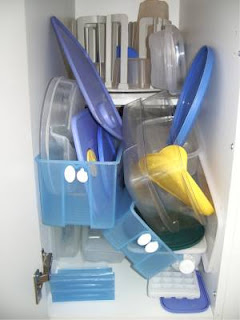
It's Tackle it Tuesday, and this morning, when my 13-year-old Rebecca was emptying the dishwasher, she got quite perturbed at the state of our Tupperware cupboard. Here's why:
She didn't want to have to shove more Tupperware in there, and since I like my kids doing the dishes, I don't want to do anything to discourage her enthusiasm.
So I thought I'd better tackle it!
I ended up throwing out three containers which were redundant. Then I found three expensive Tupperware containers I bought once that are supposed to keep veggies fresh in your fridge for much longer. I thought perhaps I should actually put them in my fridge with veggies in them. Seemed like a revolutionary idea, so I did.
When all was said and done, it took me maybe 10 minutes, and this was the result:
So why didn't I do that earlier? And, more importantly, can I keep it this way? I sure hope so. The containers on the top rack, which go around on a lazy Susan, are the best, because they all stack and the lids fit each of the three sizes. They're my favourite and I don't use a lot of other ones. But I still never know if I'll need the big ones to freeze leftovers, so I keep them. Now to just keep them neat...
So what are you going to tackle today? Let me know!
About Me: I'm a Christian author of a bunch of books, and a frequent speaker to women's groups and marriage conferences. Best of all, I love homeschooling my daughters, Rebecca and Katie. And I love to knit. Preferably simultaneously.













 Stumble It!






 for Amazon.