I know many of my faithful readers could probably give us all lessons on frugality! Many of you are just so good at making a dollar stretch. I sometimes find it hard to talk about this issue because most of you know that my husband is a doctor. Money just isn't a concern for us like it is for many others, and everytime I write about how we should spend less I get nasty emails telling me that I don't know what I'm talking about and I should just shut up. So I often steer clear of the subject.
But I'd like to add my thoughts anyway today, and please don't send me nasty emails!
First, a little context. I grew up to a single mother in a lower-middle class home for most of my life. Her jobs got better as time went on, but we were never well off. So I learned the importance of working and saving as a teen, and I knew that if I wanted to go somewhere on a trip or if I wanted to buy something big I'd have to pay for it myself. And I did.
When we married, and started having children, Keith was still in residency and making hardly anything at all. The banks were willing to lend us tons of money based on future earnings, but we didn't take out loans. We lived in an apartment (many of his classmates bought houses with no money down), and we didn't have a car. I shopped at second hand stores. And during those years of his residency we managed to save a fair amount for a downpayment, so that when we bought our first house we didn't borrow the whole amount.
The banks would give us $450,000 for a house based on his projected earnings, but we bought one that was 1/4 of that in a regular middle class neighbourhood with lots of kids. It was marvelous! We lived there for nine years until we paid it off and bought a slightly larger home, still in a primarily middle class neighbourhood. Very few doctors live around here.
I'm not saying this to toot my own horn; I'm just saying this because I do believe we've practiced what we preach in this area, at least. The one area we spend too much on is travel, having taken the kids on a whole bunch of missions trips, but I think that has lasting impact.
Anyway, here's the other reason I'm saying this: because we have consistently lived below our means, we've managed to save a lot of money so that my husband can conceivably cut back on work in the near future and we could potentially go overseas for a few years for ministry. I still don't know if that's where God will lead us, but the main thing for us is that we have the option.
And that's what living below one's means does for you: it gives you options. You aren't tied to a job you hate in the same way because you have a buffer. You can pursue more dreams. You can take some time off. You can give more away.
And living below one's means has very little to do with income and a lot to do with attitude. You wouldn't believe the number of physicians in our social circle who are close to bankruptcy. They make a ton of money and they're not saving it or treating it responsibly. Just because one makes a good income does not mean that one spends it well.
I ran across a few statistics a while ago that I think are quite interesting about the difference between millionaires and non-millionaires. The long shot? Most millionaires don't buy really expensive things. They're millionaires because they buy regular stuff. The people who buy the expensive stuff are people who are trying to LOOK like millionaires, not people who actually are.
* Eighty-six percent of all prestige or luxury makes of motor vehicles are driven by people who are not millionaires. * Typically, millionaires pay about $16 (including tip) for a haircut. (this must be for guys!) * Nearly four in 10 millionaires buy wine that costs about $10. * In the United States, there are nearly three times as many millionaires living in homes with a market value of less than $300,000 than there are living in homes valued at $1 million or more.
When we live below our means, we're able to save more and eventually be worth more, which gives you options. When you live beyond your means, then you're committing yourself to having to earn a whole lot of money to pay off that debt. You're limiting your options.
So wherever you find yourself today, with whatever income, remember to live below your means. If you do so, you'll be acting more like a millionaire than you think! And you'll be helping yourself immeasurably!
I don't have time to write a long post today, but for your viewing pleasure, I present this hilarious video on how to get out of debt fast. It's got one simple tip. See if you can pick it up:
Yesterday I asked "are you called or are you driven"? Do you feel like your life is out of control, or can you peacefully move forward, knowing God is leading?
Living Tight
Today I want to look at that question in relation to our finances. But before we do that, look at that picture of a house at the top of this post.
Small, isn't it? And yet the majority of North American families in the 1950s lived in something that looked pretty much like that. After World War II, we radically expanded the idea of home ownership. Instead of renting, people bought these little houses, and they, by and large, thrived in them.
Was it tight? You betcha. Often three bedrooms with four or five kids, so 2-3 kids would have to share a bedroom. Bunk beds became major furniture items. The living room was small, so people sat on the couch and the floor to watch TV. Kids did homework at the dining room table.
My husband grew up in a house like that: four boys, one bathroom, small kitchen. And they survived just fine.
Am I about to write a post telling everyone you should run out and buy that house? No, of course not. What I am saying is this: many of the things we think are absolutely necessary are not. It is simply that we have listened to our society and we have turned many wants into needs. And that is part of what is making our lives so harried!
Today I want to talk about how to make decisions about work, because one of the biggest issues you will face when it comes to quality family time is whether or not both parents work outside the home. It's just a fact. I'm not going to talk about whether or not you should leave your child in day care; I've already done that here. I'm not going to talk about how you can make money if you stay at home; I've done that here. I'm also not going to talk about the fact that often it costs so much to work that it's not worth it, because I've done that here (and read the comments!).
What I do want to talk about is how we can get off this merry go round that tells us that we NEED so much stuff. Work, you see, is directly related to expenses. Lower the expenses, and a job is not as much of an issue. Increase the expenses, and you have to work.
So let's ask this: what was the quality of life like for people growing up in those tiny homes?Of course, so much depended on the family. But the size of the home was not necessarily bad because people adjusted. It was all they knew, and they felt grateful to have a home. Let's also remember that in most parts of the world, far more people are squeezed into far smaller spaces than even that house represents. We are the strange ones, living with our huge homes. Our grandparents, in these small homes, were not strange. They were more the norm.
What did people do with less space? The kids played in the living room together, or in the basement. They didn't hang out in their own rooms, away from their siblings. They tended to be together. They went outside more since inside was cramped, and thus they got more exercise, even in the winter. They didn't spend as much time on television, because families usually only had one, and sometimes Mom and Dad would want to watch their programs, and the kids had to scatter. They played board games. They made Lego. They played with dolls. They used their imagination.
And that was okay.
Dreaming Big
When you were 13, did you love bridal magazines? Did you used to read them and stare at the pictures and imagine what your own wedding would be like? Many of us did. But many of us still do--we just replace the bridal magazines with Home & Garden, and we dream of a beautifully decorated, spacious home. It's what we're aiming for. We want to have "arrived". We want the space, and the luxury.
But what if that space and luxury comes at the expense of massive amounts of your time--or your husband's time? For it is not just women working that this quest for more stuff affects. It's also men working. A few years ago we made the decision that my husband would work less so he could be home with the kids one day a week. Because he was on call so much, he was often gone at night, and he was missing out on so much with them. So he decided to work less. We gave up some money so that he could gain some much needed time. That's what it all comes down to.
Not surprisingly, when we trim our expenses, we're often able to build wealth and increase our security. Millionaires, for instance, don't tend to act like millionaires. It's those with less than a million dollars who consume all the luxury stuff, because they're acting like they want to be millionaires. Here are just a few stats I picked up from the Growth Matters blog:
•Eighty-six percent of all prestige or luxury makes of motor vehicles are driven by people who are not millionaires. •Typically, millionaires pay about $16 (including tip) for a haircut. •Nearly four in 10 millionaires buy wine that costs about $10. •In the United States, there are nearly three times as many millionaires living in homes with a market value of less than $300,000 than there are living in homes valued at $1 million or more.
The two things to take away so far? We can surely survive on less than we think, and yet at the same time society is lecturing us that we need more--and we're believing it.
Think "Enough"!
Imagine how we could change the culture if we just said, "Enough!". Enough credit card debt. Enough working round the clock to afford all the latest gadgets and the big cars. Enough stress from living beyond one's means. Enough believing that life is all about entertainment and stuff instead of about family. You see, the best things in life aren't things at all. But we seem to have forgotten that. We think our kids need stuff, when what they really need is us.
Here's a family that gave up the rat race and decided to "live in the middle":
His income has stayed steady at roughly $20,000 a year. Lola earns about $30,000 plus benefits working part time as a medical technician in a nearby hospital lab. A decade ago, the couple earned twice as much — about $100,000 a year. Gregg sold insurance, and they lived in tony North Scottsdale. But he wasn't happy.
"We were on this treadmill of making money, making as much money as possible every year, and feeling that we always had to increase that because we wanted to buy more things and live in a nice house and have nice cars and everything else," he says.
At the same time, Lola didn't get a job she'd dreamed of, working at the Mayo Clinic in Scottsdale. That's a painful memory.
"I remember I prayed, I prayed so hard. I still didn't get a job. But there was a sense of letting go," she says.
Perhaps you need two incomes to get you to the minimum that you can afford a house, even a small one like that. That's okay, as long as you've prayed about and you're trying to meet your family's NEEDS, not WANTS. But many of us are on a treadmill trying to meet WANTS, and it doesn't work.
Now, those who know me are going to say it's easy for me to suggest all this, because I'm not in that position. I've got it made. And I do. My husband is a doctor, and we're able to live quite comfortably. But it was not always that way. Both Keith and I put ourselves through school. While he was in training and the kids were born, we lived in a small apartment, without a car. I spent my life with the girls taking them to playgroups and museums, because the apartment was too crowded to stay in during the day. Others in training had taken out the massive loans the banks were offering, and they had bought vehicles and homes. We didn't. We saved for a downpayment.
And then we bought a nice house, 1400 square feet, in a neighbourhood where no doctors ever lived. After ten years, we moved to the house we have now. We have always paid cash for our used cars. We buy our clothes at second hand stores. And we endeavour to take as many missions trips as possible and to give as much away as we can.
Yes, I have it easy, but even when we didn't we made the decision to live "small" so that we could enjoy life more.
The Benefits of Downsizing
The best thing some people could do is to sell their home and downsize. Yesterday in the comments Kristy shared that's just what she's doing--downsizing to get their finances under control. Unfortunately, that's not so easy right now with the glut of houses on the market. Many people will have to remain in the house they're in simply because you can't get a decent price right now. But maybe there are other things you can do. Buy a used car instead of a new one. Eat out less. Learn to save money on the big things, like electricity, insurance, utilities, car payments. And learn to save money on the small things, like groceries, eating, shopping. Many women basically "earn an income" by staying at home and putting a lot of time into saving money!
Is it fun? It can be! Think of it like a challenge, to make the money last. Give up some extracurricular activities with the kids, but replace it with fun family time, where you play games or have parties every week. Stop going out for dinner and have people over more. All of these things are "fun".
Our society cannot go on the way it is, with so many living beyond their means. We are crushed in debt at every level--personal, state, federal. We have built a beautiful society, but it is built on sand. One day it will come crashing down, as it has already begun to. I want to be ready, by raising kids who don't need stuff. Who don't ask for a huge list at Christmas, but instead look forward to all the games we play that day. I want to live with less so I can live more. That's getting back to what's really important.
So here's your exercise for today: examine your 10 biggest expenses on a monthly basis, and ask if they're necessary. Can you downsize? Are these things you want, or things you genuinely need? Can your family develop a new way of looking at money, as something that works for you to build wealth, rather than something that slips through your fingers and is a source of stress? Can money be the vehicle that you help others with, instead of something you're always desperately worried about?
For some it's a hard switch, because you're already living bare to the bone. For many of us, though, we just need to change our habits. Tell me in the comments what you think. Have you ever downsized? Have you ever chosen to forego something big? What did it feel like? Let us know!
UPDATE: Welcome, Organizing Junkie readers! Glad to have you here! I've got tons more articles for simplify your life month, as well as lots on parenting and marriage, so stop by and look around! And if you liked this, be sure to share it on Facebook below!
We live in a consumer culture, which is based on two principles:
"I deserve to be happy."
"I could be happy if I just tried a little bit harder."
That's what our culture sells us. We deserve to be happy, and the route to happiness is all around us. It's at the makeup counter, where blissful, beautiful women shine. It's at the travel agency, where frolicking couples head to the Bahamas. It's at the clothing stores, where ecstatic models drape themselves in the latest fashions. Happiness is easily attained, if only you buy the right stuff.
Then you buy it, and you're not happy.
Because you're still missing something. And the whole cycle starts again.
I've never really been into this cycle. I just couldn't be bothered to try to get the brand names, or the latest fad, or the best shoes. My biggest thrills tend to come from Thrift Store excursions, when I pick up a bunch of clothing that's perfect for my kids and light on my pocketbook. It makes me feel like I have conquered the world!
But just because I'm not into brand names does not mean that I haven't been sucked in by our culture as well. Think of how much you define your happiness by something you can pay for. When you're out with your children grocery shopping, and they've been particularly good, what do you say?
"Let's go get a treat!"
When you're at home and you're just really grumpy, what do you do to give yourself a pick-me-up?
"Let's go shopping!"
Even if it's just to the corner store to get a chocolate bar, or to the thrift store to get a new outfit.
And what is it that we do for fun? It's all things that cost money, like computers, and televisions, and boats, and restaurants. We have lost the art of just being, of just living, of just breathing in the glory of the day and the wonder of the people and relationships all around us. We have lost the beauty of revelling in God alone.
This consumer culture is very difficult to break out of, because we are so immersed in it. The Israelites, back in the Old Testament, used to get in trouble rather routinely because they started worshiping idols again. Did you ever read that in your Bible and think, "Boy, they must have had really low IQs back then to go to an idol when they had the God who parted the Red Sea with them the whole time!"
It's easy to judge a culture that lived 3,000 years ago, but I think we do the same thing. We have a God who has given us everything, but where do we turn for happiness? We usually turn to something that the wallet can buy, because we have bought into society's lies that "we deserve happiness", and the route to happiness is to try a little harder--to buy some more, to earn some more, to spend some more. It's always just a little more.
When you are attempting to survive on one income, feeling a little hard done by is a natural reaction, I think, because you aren't going to have those things that people now think of indispensable. You may not have your own cell phone, let alone an iPhone. You may not have your own personal laptop. You may not even have bedrooms for all your children, or a separate freezer, or a new van. You may not have all these things which every family "needs". But why did we ever decide that families needed these things?
What families need, I think, is time together. They need time to play and laugh and have fun and learn of each other. They need time to learn character lessons, to pray together, to explore God's creation, and little of that costs money. The best fun we can have is just being together and laughing together, and that is a joy few in this world know. For most families, togetherness is sitting at the same table while each person is on their individual iPhones. That's not right.
We live in a world that wants to keep us perpetually dissatisfied, because then it can sell us on the idea that to be satisfied all we have to do is buy one more thing. That's how our economy works. Do you think we all actually need all this junk? Of course not! But they're trying to sell it to us anyway. And much of the current crisis that we're in economically is because people thought they deserved everything, when they contributed very little. We are living beyond our means, and now the markets are catching up. We aren't saving; we're putting things on credit. We can't survive for long when it's all fictional. A new realignment will soon come, when people will be forced to live within their means again, and I think that's a good thing.
It means that over the next year or two, if we're lucky, frugality and responsibility may come back in style. It won't be about conspicuous consumption as much as it will be about keeping one's head above the water. And perhaps, as families realign their goals, they'll realize that all this stuff didn't keep us happy anyway. The more stuff you have, the harder you have to work to pay for it and to keep it up. How much better to work less and to still have time to read to your kids!
So if you're feeling dissatisfied, shake it off. It is not your fault. To feel dissatisfied is not necessarily a sin; I think it is more of a temptation in this world that is trying to sell us on constant dissatisfaction. To nurture dissatisfaction, though, is going down the wrong path. If you're sad about all the stuff you don't have, think about what you do. Think about how you don't have to be a slave to all of these things that you wish you could buy; instead you can be free to find more creative fun. Families usually do better that way, anyway.
A constant danger that was warned about in the Old Testament was that people would get fat and forget the Lord. They would have all they needed, and so wouldn't need Him. We have lived in a very fat age, and we have found that it does not satisfy. Take that realization as a good thing, and not as a disaster. Yes, this world is worrisome right now. Yes, the future is uncertain. But that just means that we're going to get back to what is important, and we'll be thrown back towards God. And maybe, just maybe, the next time we think of the word "treat", we won't pull out our wallets. We'll look down at a giggling todler and climb down on the floor with him and play airplane. Wouldn't that be fun?
Do you feel rich? You likely don't. Few of us do, and especially in this recession, many of us are understandably worried about money. We're not sure how the bills will get paid. We're wondering when our husbands will find work, or better work. It's tough.
And I don't mean to diminish that. I just want to add some perspective. Here's something I read on the Sarcastic Christian blog that made me think:
If you make $25,000 per year (about $12.50/hr) you are in one of the top 10% richest people in the world! If you make $35,000 per year, that puts in in the top 5%. If you make $45,000 per year, you are in top 1.72% richest people in the world!
Wow. You probably think you're stretched, but most of us, reading this blog, are at least in the top 10% of the world, at least when it comes to family income.
Most people in the world wonder where their next meal is coming from. We worry about what takeout we might order tonight.
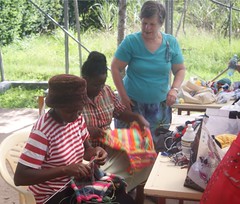
When I was in Kenya recently, one of the biggest delights was sitting with several Kenyan women just chatting as I taught them how to use knitting machines to start a micro business. (Here's my mother with two of our "students"). One woman, who had been rescued from the street when she was 10, and was now a married mom, asked me what we "plant" here in Canada. She wanted to know what crops my husband and I grow, because in Kenya, that's the main thing. Everyone grows something, and one's crops determine one's wealth. It's inconceivable that one wouldn't grow crops.
I explained the kind of crops that grow in my area of Ontario, without going into detail that the only crop I actually grow rather well is dandelions.
Another shocker from our first trip to Africa was how expensive sanitary pads are. They run about the same price as they do here, with the only difference being that there people only make about $1 a day. If you made $1 a day, could you afford pads? Probably not. And that's why many Third World girls and women miss a week of school and work every month because they literally have nothing to use.
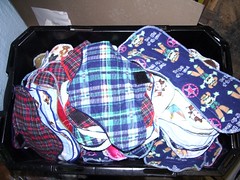
One of my pet projects in Africa was showing the women how to sew sanitary pads out of rags (and fabric scraps from their sewing school). We got quite good at them!
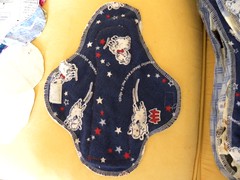
They're just flannel on top, two layers of towel (or four layers of flannel) in the middle, and then fleece on the bottom. Here's another one:
Kind of cute, aren't they?
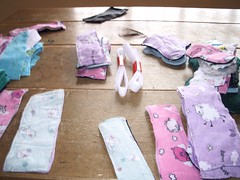
Here's a stack all cut out and ready to go on the sewing table at the orphanage. They just loved them (although everyone acknowledged they're a pain to wash). But women have been washing them for centuries, and they'll figure it out.
It's a little thing, sanitary pads. We take them for granted. But that just shows how rich we really are!
I know many of you are struggling with money right now. Remember, though, that we have been given so much here, and no matter how bad things get, God has still given us so many blessings. If you're burdened with worry today, think of these girls in Africa, so thrilled just from a little piece of flannel. We have much to be grateful for, and remember that this, too, shall pass.
Every Friday my syndicated column appears in a bunch of newspapers in southeastern Ontario. I'm posting this week's a day early because tomorrow is Good Friday. So here it is, based on a blog post from last month. I hope it inspires people to start saving!
Let me give you the stories of two men. One we'll call Jim. He married straight out of high school—rather an anomaly today. He didn't go to college, but immediately took a job at a financial planning firm in Windsor. He became certified in investments, and worked his little butt off building his own client base. He looks about 12, but he always dresses impeccably in suits.
Jim’s first child was born two years ago, when he was about 20 or 21. Today his family is still doing quite well, despite the economic downturn. They’re saving up for a downpayment on a house, building their little nest egg at a time when most men his age are still living in their parents’ basement. At one point Jim would have been quite typical; today he sounds like a dinosaur.
Now let's talk about Bob. When Bob was Jim’s age, marriage was the furthest thing from his mind. He concentrated on working as little as possible so that he could play as hard as possible. He took extended vacations to the Caribbean so he could scuba dive, renting apartments with other twenty-somethings. He lived a carefree life until well into his late thirties, working odd jobs, minimizing his income and maximizing his fun.
At 38, though, he met the woman of his dreams and settled down. They’ve since had three kids, and while both he and his wife are working, money is tight. They’re starting almost twenty years after Jim did, and neither of them used those in-between years to shore up any sort of nest egg.
Many people just don't worry about saving when they're single. But in the long run they do themselves a disservice, because when they do marry (if they do), they've lost about a decade or so of good earning years and saving years.
Now 44, Bob is juggling saving for a house, putting money aside for his kids’ education, and contributing to an RRSP. He’s in a really difficult bind, because time is no longer on his side. He has to put money into an RRSP if he’s going to have anything at retirement, but he also has incredible family expenses right now, too.
One thing Jim teaches his financial clients is that if they save $2000 a year in a retirement account from ages 19-26, as he is planning to do, they can then afford to stop for a bit and save up for a house. If you wait like Bob did, though, and don’t start contributing until you’re in your late thirties, putting in $2000 a year until you’re 65, guess who has more money in the end? Jim does, even though he actually contributed far less. That money has more time to accumulate and grow! It's starting early that makes all the difference.
If you’re in your twenties right now, even if you don’t have a family of your own, chances are one day you will. And if you want the rest of your life to be much less stressful, squirrel away money for a house and retirement now, before you need it, to avoid feeling the crunch later. I know cash is short when you’re in your twenties, but you don't need a big-screen TV. You don't need to eat out every night. You don't need all the latest gadgets. It may seem like responsibility is a long way off, but think instead of these years as the breather years. You don't have any major expenses, so now is the time when saving is actually the easiest. Don't just coast through life until responsibility hits. Act responsibly now, and you'll be so much more comfortable in the end.
Don't miss a Reality Check! Sign up to receive it FREE in your inbox every week!
One of the strongest messages in our culture is "You'll be happy if only you buy this." And it has a twin sister who says the same thing, just backwards: "the reason you're not happy is because you don't have enough. So go shopping!"
Everything in our culture revolves around shopping. Magazines try to sell us stuff. TV shows are punctuated by commercials. Movies have product placement. And even when there aren't specific ads, the people are so beautiful that we want to buy what they have, just so we can be that successful, too.
It sure is hard on one's wallet. But even worse, it's hard on our hearts, because what culture really sells us is dissatisfaction. You can never be completely happy because if you were, you wouldn't need anything. You'd have no need to shop! Hence, they have to make you unhappy so you'll head to the mall!
If you're a mom trying to make ends meet, it can be frustrating. And often we spend months scrimping and saving and depriving ourselves, and then what we want more and more is to splurge on something. We deserve it! And it doesn't seem fair that we should always be the ones losing out.
It's funny that we should think that way, because in reality, most young couples with kids who have big homes and vacations and new clothes are heavily in debt and bordering on bankruptcy. You're probably in better financial shape than they are, if you are watching your pennies and budgeting for stuff. But television rarely shows people living in small homes with hand-me-down clothes. I'm amazed at the shows and movies I watch where people with a relatively low-income job still live in a huge house. It's unrealistic. They're the ones who are wrong, not us!
So how do you come to the point where you can be happy with fewer things, but more time with family and less stress about money? How can we find peace without materialism? There's a (surprisingly) good article here at wiki on it, and let me share with you a few of their points.
1. Limit television, movies, and news watching, because it will make you feel inadequate.
2. Don't go the mall for fun.
3. If you want something, make a 30-day list. If you still want it after 30 days, and think it's worth the money, talk to your spouse about it and then decide whether or not to get it.
4. Make a gratitude list instead of a shopping list
.
And there's so much more! I, of course, would add prayer and reading Scripture, because it focuses your heart on what's really important. Even just play praise CDs throughout the day to keep your mind thinking about God.
But now I'd like to ask you: how can you defeat materialism? Leave a comment, and let's see if we can make our own lists!
A while back we had a long conversation on this blog about the cost of working. If you've got little kids, we asked, and you have to pay for childcare, then does working outside the home even contribute to your income in a substantial way?
For instance, one of the things that stay at home moms can do is to figure out how to live on less. We do have more time to do things like cook from scratch, make our own gifts, spend more time shopping for bargains, etc. We can only have one car, even though that may mean chauffeuring hubby to work so we can keep it for the day. I also find that when I'm tremendously busy, either because of speaking or because of events with the kids, it's harder to make dinner. That's when we go out or eat prepared foods, which adds to the budget. I know if I were working full-time I'd do the take-out thing more often, and so that would become more expensive.
Therefore, I'm not sure it always pays to work, depending on your potential income. But what do you do when you just really need money? I want to throw this question out there, because several of my long-term readers really need answers, and I thought together we could come up with something.
So here's the scenario. You aren't highly educated, and the maximum you could probably make would be $15/hour, and that's if you hit the jackpot. But you really need to bring home about $1500 a month just to make ends meet. So what do you do? Here are some choices that I see:
1. Work part-time. It sounds silly, but part-time work may be able to bring in more money. When you're not paying for childcare because your husband has the kids, and when you can still live on one vehicle, part-time work may actually leave more money in the wallet. Work two nights a week and Saturdays. Be a waitress, or work at a call centre or something. The disadvantage: you never see your husband. You don't really have family time. So I'm not a big fan of this one.
2. Sell Mary Kay/Tupperware. I'm not an overly big fan of this one, either. I've gone down that route briefly, and gone to all the sales conferences, and gotten all pumped up to sell stuff, and become a leader, and have people work under me, but it just doesn't work that well. You can work so hard at it for a few years and still have little to show for it. It works great for some--but for the majority it doesn't. And you spend your life out at nights and trying to convince women who don't really want to go to parties to go to just one more. Let me know if you think differently, but I know one of the women who needs money advice has already tried this and won't do it again.
3. Become a foster parent. Don't balk at this one right away. I'm not saying we should do it for the money. I don't know what all jurisdictions pay, but in mine, if you take in two kids you make up that monetary gap we were talking about. It's a lot of work. It's a big sacrifice. You have to define your boundaries. But if you are willing, it has a lot of upsides. You're really making a difference. You're living out your values. You are still able to stay home and be with your own kids, and if they're in school, you're able to get them on and off of the bus or be there for their field trips and sports games. You have to be careful who you take, but this can be an option for some, and given how desperate they are for good foster parents, perhaps it's one more of us should consider (even forgetting about the money!). Any foster parents out there? I'd love for you to comment on this option!
4. Help your husband to make more money. After all, you need more income. It doesn't really matter who gets it. So how can we help our husbands boost their incomes? Can we help them start a business? Can we help them with that business by doing some of the work at home? Can we support them going back to school for a time to get more training? Any thoughts on this one?
5. Save more money. The other way to make money, of course, is simply not to spend it. If you've got a major shortfall, look at what you can change in how you spend money to perhaps make some of that up. That's not always possible; I know a lot of people are already living pretty close to the bone. It's just a thought.
6. Start your own business. Lots of people are doing it. Sell on e-bay. Turn a hobby into a business. Especially at Christmas it's easier to make some money. Any concrete suggestions here?
So what do you all think? What's the best way to boost income when you want to continue to stay at home with your kids? And if someone absolutely had to get a job, any suggestions on what kind of job to get?
By the way: an anonymous commenter took offense at my post a few days ago, saying that I was denigrating working moms in my "stay at home mom" rant. I addressed that in the comments, but in case she doesn't read them, let me just say again: I didn't mean the post against working moms. I had no idea it would be taken that way. I meant it against PEOPLE in general. In fact, the specific individuals I was thinking of aren't moms at all. Several are male. So I'm sorry if you were offended, but I really think it was just a misunderstanding.
Over at Townhall.com this morning, I read a tongue-in-cheek column by Rachel Marsden on men's underwear purchases being an indicator of the recession. The theory goes like this: when money's tight, men will let their briefs get tight, too. And holey. And frayed. No one sees them anyway, so they'll stretch out their purchases.
This has some logic to it, since my husband doesn't really care about the state of his briefs. But the problem with the theory, in my mind, is that MEN DON'T BUY UNDERWEAR. At least my husband rarely does. I buy it for him, usually at a discount store.
In fact, my husband doesn't buy much clothing at all. I think that's true for most men. They let their women dress them, if they're smart. When we were married Keith had these disgusting pair of grey sweatpants that he had worn since he was 14. They were one of the first things that went in a bag to the Salvation Army. Of course, he was angry, because they were COMFORTABLE. But they were also gross. And bit by bit, I replaced my husband's entire wardrobe.
So for underwear to be a sign of the recession on a large scale, women would have to decide not to buy men's underwear. And I'm not sure we're at that point yet.
But Marsden makes the point that what a recession is good for is teaching us to shop smarter. We don't buy all the Starbucks we used to because we realize McD's is cheaper. Or we can just make our own coffee and carry it in a thermos. We don't buy bottled water when the tap stuff tastes fine.
I have to admit that our family is not really hurting from the recession. My husband's job is very secure, and my income is fine. But one of my practices every September is to re-evaluate our family's budget and figure out whether we're really on track. And one place that we fall short is eating out. We don't buy a lot of clothes. We don't have expensive hobbies. But we do eat out too much.
One of my resolutions, then, is to keep the house stocked with things that are easy to make for lunch and dinner. And to stop us from ordering pizza or going out, I'm going to start buying some frozen meals. I didn't used to before, because as a rule I'm against them. They're not healthy, they're expensive, and they don't taste as good as my own cooking.
But often the reason we go out is because I'm too tired to cook, or we're pressed for time. If we had frozen meals, I'd make them. And $4 a meal is a lot cheaper than $12 or $15 at a restaurant, plus drink and tip. Especially now that my girls are starting to order off the adult menu.
The trick, of course, is to save those frozen meals for emergencies, and not just make them because they're easy, but so far it's working out quite well. I also cook double quite frequently and freeze the excess, too, so my freezer is well stocked. But what I'm finding is that while my grocery bill is going up, my restaurant bill is going down.
And Keith's underwear is still pretty hole free.
What about you? Where have you cut back? Where do you think most of your money is wasted? I'd love to know!
Okay, maybe that headline is a bit of an exaggeration.
But I face a dilemma when it comes to parenting. Most of us hope that our children will surpass us. That they will be more successful, more leisured, more content.
While the more content part is always possible, the fact is that in my family it is very likely that we have reached the pinnacle of wealth. As a physician, my husband makes a very good income. We do our best to save a chunk, give a lot away, and live in a nice but still upper-middle class home. We don't have a cottage. We don't have a boat. We don't have first class furniture.
But it's very unlikely that my children will have this kind of income. It's far more likely that they'll struggle to get by, like everyone else, and like we did when we were starting out.
So one thing I've always been conscious about in my parenting is to teach my kids how to be frugal, and how not to expect that money will always be easy, or that they can always buy whatever they want. Here are some of the ways I've done this:
1. Start Allowances Young
When the girls were three, they started with allowances. They earned $1/week per year of age, which they had to divide up as follows: 10% tithing, 30% spend now (usually chocolate), 30% save for something they want, and 30% university. They do that with every bit of money they make, even today when my oldest makes a lot from baby-sitting and selling homemade jewellery.
And with that came the responsibility for buying their own treats. They've had to buy their chocolate bars and their ice cream cones. Sure we've bought our share, but on the whole, they know not to ask me for candy. If they do, I always reply, "did you bring your money?". That way they learn the value of money, and that they need to think about what they spend their money on.
I have a whole chapter on teaching kids good responsibility with money in my book, To Love, Honor and Vacuum! Do you have it yet? If not, you can get an autographed copy here, or get it from Amazon:
2. Start Clothing Allowances Young
When my oldest turned 13, she received her clothing allowance. Now she has to keep track of her money, and all the things she'll need to buy this year. I sat down with her in January of that year (her birthday happens to be at the beginning of the calendar year, so it's handy), and we went over all the items of clothing she'd need. I paid for the basics: a certain number of pairs of pants, certain number of shirts, dresses, etc. And I didn't pay a lot of money, since often we buy at thrift or second hand stores. So I gave her an allowance of about $9-$10 a shirt, for instance, not the $20 that it can cost new in a store.
And then I handed her the money. And she made it last! She's not doing as well this year, but then, she's also making her own money, and soon she'll have to dip into her own to buy her clothes. And that's fine, if that's where she chooses to spend her own money. At least she's learning how to budget!
3. Charity is Non-Negotiable
I suppose it's strange to say that we "force" charity, but we always have. We've demanded that they tithe, and every Christmas one of our rituals is poring over the Christmas catalogues we get from charities and dividing up the remaining charity money for that year, both theirs and ours. We pray over the needs and send it out.
And what I've found is that the girls are becoming generous on their own. Rebecca has frequently given away all the money in her wallet to a friend on a missions trip, or an appeal. And she's done it cheerfully. When you raise them from the beginning to understand that it's not our money, it's God's, they have a better attitude. We've also been to Kenya with them twice to help them to see what an African orphanage is like, so they know how much we have. And I think they get it.
4. Buy Second Hand
We buy everything second hand. We buy clothes second hand (not always, but we do check the second hand stores first). We buy cars second hand. We're bargain lovers! We don't need to be, but even if you have the money, why wouldn't you try to save? It gives you more to give away!
And then the girls learn how to find a bargain when they're older.
5. Cook Cheaply
One of my favourite things is teaching the girls how to cook (I began when they were 10) and helping them to figure out how much different meals cost. At every dinner we often have that discussion: how much was this meal per person? It helps them to see which is an expensive meal and which is not. It also helps them to see how expensive restaurant eating is (and that's the big failing I have as a parent. We eat out way too much). But I love cooking with leftovers, making casseroles and homemade soup. And then they see how cheaply you can get by! I have visions of them in university feeding a whole pile of friends because they'll be two of the few who can cook, and they'll know how to do it inexpensively!
What tips do you have about teaching kids about money? I'd love to know! Leave them in the comments!
Every Friday my syndicated column is published in a variety of places, and here's this one, about our current economic crisis. See what you think (I'll add my own thoughts at the end):
Modern economic practice involves a lot of wishful thinking. Many politicians believe that you can spend billions bailing out car companies and auto unions, and magically consumers will buy from these companies again. People aren’t much better. We think we should be able to buy whatever we want, whatever our income.
Recently two young, married friends of mine arrived back from four years of university ready to launch into their adult life. She’s got a job, he’s about to land one, and they’re living with her mother.
That may not sound like much of a success story, but they have a plan. By the end of the summer they’ll have paid off their student loans. By next spring they’ll have the downpayment for a house. They’ve scrimped and saved, paid for their used car in cash, and collected hand me down furniture. They may not have much now, but they’ll succeed, because they know how to exercise self-restraint.
Many people don’t believe in saving money for a purchase. They plop down their credit cards for everything, and then can’t make the payments. The credit card companies jack up the interest rates, and these financial dunces either take years to pay it off, or they default.
Last week, Obama decided that those with bad credit histories shouldn’t have to pay such exorbitant rates. He demanded that banks stop hiking rates without warning, and put some measures in place to protect the young. Our Finance Minister followed suit. Flaherty forced credit card companies to inform customers clearly before the rates get hiked, and he gave customers a reasonable chance to pay their bills before interest is charged. It was a good compromise.
But some opposition parties didn’t think this went far enough. One NDP proposal floating around was that credit card interest rates should be capped at 5% above prime.
Yet the banks only charge these high rates because some people are high risk. If you pay your credit card bill on time, in full, you don’t have a problem. Those high interest rates only kick in when you don’t.
Maybe you think that’s not fair. But if you limit what banks can do with their high risk clients, you run into two problems. First, banks will just charge their good customers more, in the form of higher annual fees or fewer rewards programs. Those good customers, who are only in it for the air miles, will turn to debit cards instead, reducing the profitability of credit card companies. But more importantly, banks will stop lending to those with bad credit. Only the wealthy and those with good payment histories will be eligible for credit.
It’s a similar dynamic to the recent American proposal to force employers to give their employees one week of paid vacation—rather than just give them the time off. What lawmakers seem to forget is that if a company employs 100 workers, and you suddenly tell them you have to pay each of those workers for one week of vacation time, two of those workers will likely get fired, especially during a recession where money is tight.
Too many legislators think that their policies exist in a vacuum. They mandate something, and everybody will do it, without changing anything else. Legislators want to force people to be generous, but the world doesn’t work that way. They can’t force companies to take on higher costs without repercussions, any more than they can force people to buy Chryslers again.
We are in this mess because government, banks, people and unions got too greedy. We’re not going to get out of it until everyone tightens their belts, acts responsibly, and learns basic economics. I wonder how long that will take?
I was talking about this issue last night with family when they took me out for a belated birthday dinner, and it came out that Canadian banks are still making record profits. The banking industry in Canada is the only thing not really affected by the recession. It's doing great. That's not to say that I disagree with what I wrote; just that maybe we need more competition, of people who will lend money to those with good credit histories for less. Right now, even if you have a stellar record, you can't get less than prime plus half. That's ridiculous when banks are making a ton. Anyway, that's just my take!
Don't miss any of my Reality Check columns! Sign up here to get them delivered FREE to your inbox every week!
Every Friday my Reality Check column appears in several newspapers. Here's today's, which is based on a blog post from last weekend. I'm Canadian, so it's from that point of view, but maybe it will encourage some of you Americans, who are distressed at your economic news, to come join us up north! Hope you enjoy it!
When my oldest daughter turned thirteen I gave her a clothing allowance. We sat down and calculated what new items she’d have to buy that year, and how much they were likely to cost, and I handed her a cheque. That money had to last her for an entire year. If she bought too much and ran out of money, tough luck.
She did very well, mostly because she developed an amazing affection for thrift stores. She realized she could buy stuff cheaply and then keep the leftover money!
Actually living within one’s budget, though, seems rather quaint. A few years ago Steve Martin starred in a hilarious skit on Saturday Night Live called “Don’t Buy Stuff You Can’t Afford”. In the skit, a couple sits at a table, leafing through bills, when someone bursts in with a revolutionary new book on saving money. The book, though, is only a page long, and it’s called—you guessed it—Don’t Buy Stuff You Can’t Afford. The couple grapples with the concept. “So if I want it, but I don’t have the money, I can just buy it, right?” “No!” comes the answer. And on and on it goes as they struggle to wrap their heads around this once common sense idea.
As badly as we’ve blown it, though, governments are far worse. Imagine if the government had to live the way we should: stay within a budget, save 10% for a rainy day, and then give away a few percentage points to charity. Sounds like a fairytale, doesn’t it?
Canada will run a deficit this year, but that’s after a few years of surpluses and paying down debt. The Americans, on the other hand, have been overspending for quite a while, and now it’s getting worse. Up until now, “billion” was the biggest number in our common lexicon. Now we’re all trying to figure out “trillion”, as Obama throws a bunch of good money after what looks like worthless investments. Instead of rewarding people for budgeting, or providing a stimulus that helps everyone, the U.S. government in all its wisdom has decided to reward businesses, industries, and individuals who have wasted, pilfered, and gambled their wealth away. To make matters worse, those who actually do make an income, and do contribute to the economy, and do try to live within their means, are the ones who will have to cough up the cash.
And they’re not alone. Their children and grandchildren will be on the hook, too. Instead of using their own money to save for their own homes, these future taxpayers will still be paying this debt left from bailing out irresponsible home buyers. It’s crazy.
For most of my life I have assumed that one day one of my children might move to the United States, with its better employment opportunities. In the past few months, though, I have developed a new affinity for our True North Strong and Free. I believe we’ll grow and thrive over the next few years, while Americans will find their huge debt catching up with them. They bought too much stuff they couldn’t afford.
Canada’s debt is 20% of our GDP, whereas America’s is now over 50%. And debt means that eventually someone’s taxes are going to have to pay for all the money the government has already spent. All those interest payments are going to make it harder and harder for future Americans to pay for Social Security, or Medicare, or even schools.
I have no idea what’s going to happen to the economy for the next few years, but since Canada is so tied to the United States, I’m not overly optimistic. Rewarding irresponsibility and poor business decisions causes more irresponsibility! But I think the tried and true rules are still tried and true, even if government is making a mockery of them. We shouldn’t need Saturday Night Live to remind us; this should all be pretty obvious. Save for something before you buy. Don’t wrack up credit card debt. Don’t invest unless you’re prepared to lose the money, and most of all, don’t buy stuff you can’t afford. Now, is the government listening?
Don't miss a Reality Check! Sign up here to receive it free in your inbox every week!
The unidentified worker, employed as an overnight stock clerk, tried to hold back the unruly crowds just after the Valley Stream store opened at 5 a.m.
Witnesses said the surging throngs of shoppers knocked the man down. He fell and was stepped on. As he gasped for air, shoppers ran over and around him.
"He was bum-rushed by 200 people," said Jimmy Overby, 43, a co-worker. "They took the doors off the hinges. He was trampled and killed in front of me. They took me down too...I literally had to fight people off my back."
Another woman, a shopper, was pregnant and she was trampled. Paramedics came but she had lost the baby. And as both victims were being treated by paramedics, shoppers were rushing around them, few stopping.
Something is seriously wrong with our culture. How could we be so into a bargain that we literally ignore human life? Is that the meaning of Christmas?
Be careful about shopping today on Black Friday. Bargains are great, but how much better not to buy at all, and just to bake cookies? Why do we think presents make Christmas?
I know there's a balance, but may we never be caught in something like this.
I want you to imagine that this Christmas we didn't buy junk from China. We didn't buy things that would cause our children's brains to turn to mush. We didn't buy stuff with small parts that children will leave all over the floor and you will step on in bare feet and try really really hard not to say a bad word.
We didn't buy things for people we didn't like just because we "should".
Imagine, instead, that what we bought was meaningful. Not big, but meaningful. And imagine that we actually had time in December to make Christmas crafts, and to hang some decorations, and to play some board games.
We didn't spend December at the crazy mall with crazy people and slush and no parking spots.
It really can happen. It just takes courage.
I've posted on this before, but I want to state it again: we don't buy our children everything under the sun for Christmas. We do the Three Wise Men thing: we buy them gold, frankincense, and myrrh.
Well, not really. But we buy three gifts. The gold gift is something they want; the myrrh gift is something they need; and the frankincense is to nurture their soul. So the frankincense could be a book, or a journal, or a CD, or a magazine subscription. It isn't big. And the kids know that they are only getting three things. So it's not a gift frenzy.
And for the other kids in the family? Well, let's just say we're probably not the favourite aunt and uncle. But I don't care! Because here's my philosophy. If you look around your house, what is it that you still have from your childhood? It may be one teddy, but no other toys. Maybe a Monopoly game. But most of us saved some books. Some hard cover Nancy Drew or Hardy Boys. The Narnia series. Anne of Green Gables.
And so I'm the book aunt. I buy books. Classics. Books that mean something. And maybe one day these kids will get off of the Xbox and actually read them!
One little girl and boy, the "niece and nephew" that we're not actually related to (they're more adopted into the family) do read those books! They love it! Last year we bought the boxed set of Little House on the Prairie, and they've read through them out loud this year. So now I'm going to do .... well, I haven't made up my mind yet. Definitely Treasures of the Snow by Patricia St. John. And maybe some others.
But I don't want to buy junk just to make these kids happy on Christmas. They have too many junky-type toys already.
And for everyone else on my Christmas list? I'm making scarves. And putting together gift baskets of chocolates and little things, and decorating them. The make pretty gifts, but don't cost much.
But here's our main emphasis at Christmas. We bless others. We tithe throughout the year, giving to certain charities. But at the end of the year we take what we didn't spend on a lot of presents and we build wells in Africa. Or we send money so that blind people can have cataract surgery and see again. How much is your sight worth?
And if you want some great ways to do it, can I suggest a catalog? We love Harvest of Hope. You can buy gifts for people on the other side of the world, and they have a kids' section where children can take their money, and for $9 you can send a child in Sudan to school for a month. For $5 you can send medicine to a family in Vietnam. For $9 you can send Bibles to children. I'm tearing up just looking at it on the web.
So imagine....imagine if this year we didn't buy junk. We bought meaningful things. And we learned about true worship as we stop all the rushing around and just bow at the feet of the King.
That's my idea of Christmas! I'm not saying don't buy gifts. Obviously there is a balance, and we do buy things for each other. But please, make it meaningful this year. Watch this:
Thanks for stopping by! Why not stay and look aound a little at other To Love, Honor and Vacuum posts? I've got great stuff on marriage, s-e-x, a book giveaway, and more!
To fit in with my addiction theme today, I want to talk about money.
I once heard Gary Thomas of Sacred Marriage talk about what women look for in a man. He said that when women first get married, they're main characteristic they want in a husband is someone who listens to them and understands them. Seven years later that all changes. By that time they have young kids, and the main characteristic they want is someone who is a good provider.
Most women, in other words, want to be able to stay home without worrying about money.
That certainly was the case with my family. I had a great education, but as soon as held my daughter in my arms I didn't want to leave her with anybody. I wanted to raise her. So the fact that my husband is able to provide so well really matters to me.
But what do you do when you disagree with your husband about this? These disagreements, I believe, come in two forms, though I think the solution is the same for both: one, the husband thinks that the wife should work because they need the money; and two, the wife's view of what is necessary for comfortable family life far exceeds their income.
Let's deal with the first first. I have many friends who want to stay at home but their husbands don't want them to. And in fact, this is the cultural norm. Another friend and her husband are very committed to her staying home with their five children. But they are deeply in debt and he doesn't make much income. When they went to a Christian credit counsellor, the counsellor told them she had to work. No ifs, ands or buts. That wasn't an option to them, so they walked out. They're just trying to be frugal.
It's hardly surprising, then, that many men want their wives to bring in at least a little bit of income. And I see women struggling to find part-time jobs that work with their schedules. One of the most popular and linked to posts I've ever written on this blog was about Mary Kay type businesses. Women want a solution to their money problems.
Last week, though, we went out to dinner with two family members, and one made a comment: he said that nobody in our family had gotten really rich. We were all comfortable, but we weren't rich. "What's your definition of rich?", asked my husband. "To be able to go into a store and buy whatever you want without thinking about it," he replied. "Well," said my husband, "as long as you only want what's in the dollar store, then you're rich!"
And I think Keith's right.
How much money we have, and how much money we need, is entirely dependent on how much we want and how much we spend. They aren't separate from one another. And if you live within your means, you'll be fine.
Think about a family fifty years ago. They likely lived in a house that was less than 1,200 square feet. They only had one car. Each person would have had one Sunday outfit, maybe two. They had one television if they were lucky. They rarely ate steak. They had no air conditioning. And that was normal!
Today, we expect that as soon as we marry we will have great furniture, a large screen plasma HD TV, and all the bells and whistles. There's none of this living within one's means that was so common back before VISA cards. But if they could live like that and be perfectly happy, why can't we?
If your husband is pressuring you to work, see if you can figure out how to create an income simply by saving. By buying well, reducing what you actually need, and being frugal. If you're unsure where to start, search for frugal mom blogs on the internet. Tons and tons are out there, and they're all helpful!
But the bigger issue is a spiritual one. Many wives put their husbands in impossible situations because they spend too much. One of my friends recently had her husband cut up her credit card and put her on an allowance. It sounds mean and patriarchal, but she admits she needed it. She was addicted to shopping, and she was endangering their family's security. She needed to be stopped.
Do you need to be stopped? Christmas is just around the corner, so the financial crunch for families is about to happen. Why not take time right now, before you start that big shopping, and figure out how to save money this year. Knit some scarves for gifts. Make some bath salts or bath oils. Bake cookies. And reconsider what you buy for the kids (I'll post more on that in the days to come!). But don't spend a ton. And then here's the kicker: try not to feel bitter about it.
For those of us whose husbands work, let's support them in that. They support us; let's be sure to thank them. And honour them by treating their hard-earned money well. If your husband isn't a great saver, you can save money by taking some that you would have spent on Christmas gifts or groceries and putting that aside. You start being good with money, and you'll bless your household.
Money troubles is one of the biggest causes of marital stress and breakdown. And things just aren't that important. They really aren't. Does it profit your children to have the best clothes and iPods and Xboxes but to lose their parent's marriage over it? Keep your family out of debt, as much as it depends on you. Be frugal with your money. Be responsible. And your marriage will go better, your heart will be in a better place, and your children will be blessed for it.
Want more marriage help? Check out my books, but especially my downloads! My download Honey, I Don't Have a Headache Tonight is only $2 during the month of November! It's a hilarious talk that will definitely help the intimacy in your marriage!
I never really meant to post on tithing, but it keeps coming up, and then in the comments people ask questions, so here we go on another post!
Now we're dealing with the question: Does the whole 10% need to go to my church?
Please keep in mind that what I am about to tell you is my understanding of Scripture. It is not Scripture itself, and many smart, godly people have views quite the opposite of mine.
But nevertheless, this is my blog and I get to tell you what I think!
In the Old Testament, when the tithe was instituted, everybody took their tithe to the tabernacle, and later the temple. These were the places where God literally dwelled, and where all the work of God was carried out in the entire world. It was the only organized vehicle for God's work on earth. The welfare system was run from the temple. Evangelism, such as it was, was run from the temple. Everything was located there.
I don't think you can compare the local church with the temple. God does not dwell in your local church; He dwells in you today. He once lived in the holiest of holies in the temple; now He lives in your heart. So there's nothing mystical about the building, except that it is the primary place for fellowship and accountability and growth that we have today.
As such, it needs much of our tithe. But I don't think it needs all of it. Today, God's work is not only done by the local church. It is also done by organizations all over the world, and even here at home. If we're to forward God's work on earth, I think we need to be considering those organizations, too.
Our church gives about 20% of its money to overseas missions, so it's easy to say that if we give to the local church alone, the local church then takes its tithes and distributes them as it sees fit, and you're done. But I guess I've never believed that, because 80% of the money still stays in North America. And quite frankly, the work of God needs more money on other sides of the world, in my opinion, where Christians are being thrown out of their homes, tortured, or simply starving.
So we try to give half our tithe to our church, and then we divide up the rest between local missions and overseas missions, with an emphasis on the overseas. We try to give to organizations that we personally have contact with, so we know the money is being used well. For instance, my family has visited an orphanage in Kenya, and a lot of our money goes directly there today. We gave money to build a water system, for instance, and the next time we go back we will be able to physically see it. We also gave money to start up some entrepreneurial ventures in Kenya, and when we go back we can visit those, too. So it's very tangible.
I know many disagree, and many preach that the entire 10% has to go to your local church, and the offerings above and beyond that go overseas. I feel that we should all be giving at least 10% (we give more than that), but I just don't think the church is the same as the temple, since God is working in many ways today.
So that's where I stand.
And in answer to another question, yes, I think we should also tithe our time, but that doesn't mean that we don't have to give money! (which I don't think the commenter was implying; I'm just making the point). I think we just simply need to have an attitude of generosity, where we hold everything we have--our money, our time, even our kids--in an open hand, realizing that they come from God, and they're not intrinsically ours. Let's not become so burdened by things on earth that we fail to rely on Him. Let's not hoard His blessings. Let's share them so they can multiply.
That's just my attitude towards life. And when you do share, you feel a whole lot better!
In the comments below, one woman asked what to do about tithing when you really want to tithe, but your husband isn't on board.
That's a toughie. Personally, I believe that God blesses you in many ways when you tithe, especially financially. You're putting your trust in Him, and He rewards that. I also think the Bible very clearly teaches that our money is not our own, it is His. And we need to give at least 10% away.
But if your husband doesn't agree, you can't just go and do it on your own. I think marital unity demands more.
What you can do, though, is tithe the money that is in your control. So if you follow my advice and budget for clothes, and groceries, and health & beauty, and gifts, etc., and you have control of that money, you could take that and tithe it. I have a friend, for instance, who has $280 a week to spend on all household expenditures. She gives away $30 of that, because it's already in her control. Her husband has agreed that as long as she purchases what they need, the money is hers. So she gives away based on that.
$30 a week may not be much, but she's still trusting God that He will provide, and she's still honouring Him first. And you can do that.
The other thing you can do is tithe your things. If you have children's clothes that are too small, or a lot of food in your cupboards, you can be generous with that. You can be generous with your time, or with your ability to bake or make home-cooked meals. You can cook for a single mom who needs a hand, or for an older couple in the neighbourhood.
You may not be able to tithe on your income, but you can share what God has blessed you with. So get creative about it, and don't get too upset if your husband isn't on board. It's not up to you to change him; that's up to God. So do what you can and focus on that, rather than on what you can't do. And I do think that when we start trying to be creative about how to share with others, God smiles!
Interesting comments on my post about budgeting below, and I wanted to follow up with some thoughts.
First, as far as I'm concerned, if your husband has tithed on the income, and then he gives you some, you don't have to tithe. That's not your "income". That's simply money that he's put in one of his "jars"--in this case, the jar marked "Wife". So it's not new income.
But I want to get back to this idea of allowances. I actually talk about this in To Love, Honor and Vacuum in a whole chapter, but I have to agree with the commenter below who said that allowances for wives made her nervous. They make me a little nervous, too.
Let me explain. In my philosophy about marriage, and I think this is biblical, once you are married you are one. Everything is shared. There is no "his" and "hers", and there's no concept that he made the money so it's his and he can decide how to spend it. The money is yours together. He may have earned it, but you're working in other ways, and the money is for the family, not for him.
If together you both decide a budget on how much you will spend on household expenses a week, since you're the one who does the grocery shopping, etc., that's a smart thing to do. There's nothing wrong with that. But what gets me nervous is this concept that it's him handing over the money, because frequently that means that he has access to the bank accounts and she does not. That is not a safe situation to be in. What if you need money for an emergency? Or, more importantly, what if something happened to your husband? If your name is not on the bank accounts, and he is in an accident, you cannot get access to it without a lot of legal wrangling. Even if your name is on the account but you have no bank card or no credit card it's not easy to get to in a pinch.
And do you know anything about your family finances? Do you know if you have savings, or debt? Do you know what your retirement fund is invested in? Do you know if you have disability insurance (which everybody should, especially when you have young children)? If he wants to be the one to primarily look after the money, and you don't mind, that's okay. But you still need to be familiar with all of it and you need to be able to get your hands on it if you need it. It's just common sense, and it's protecting you and the children.
Philosophically, though, I do think that the husband having control over the money and doling it out to his wife as the husband sees fit is not a picture of oneness in marriage. Decisions about money should be made together. I have a sister-in-law who, as of Saturday, is no longer my sister-in-law. She married my brother-in-law, they divorced, and on Saturday she remarried.
But money was one of the big issues in their marriage. He felt that since he made it it was his. He would give her money for groceries, but he would monitor what she spent. If she spent too much on herself he'd get upset, but he could play all the golf he wanted. It wasn't an equitable relationship.
If your husband is unwilling to give up control of the money then getting an allowance is probably the best you can do. Make it as high as possible so that you can take some of it and save it for things that you know you and the children will need in the future.
On the whole, though, I think both partners should have access to the money, and both partners should decide how much you both will spend on things. It's fine to give you an allowance for household items if that's what you've decided on and if you still are firmly in the financial decision making loop. But does he have an allowance for his spending, too? Or is it only you who has to control herself?
Even if he doesn't budget for himself, of course, that doesn't remove the obligation for you to be responsible with money, and budgeting is always a good idea whether or not he does it. But if he doesn't do it, and he's asking you to, then it means that there is a mistaken idea fundamentally about the nature or marriage. Both of you need to come to the realization that what you have is shared completely. That's the way that God intended.
All of that being said, I know another woman whose husband recently took away her bank card and credit card and put her in a strict allowance. But she needed it. She had issues with spending too much and she was endangering the family's well-being. She laughs about it, and feels that he was right. And it has changed her habits. Last week when her son had to be do a project for school, she would have normally gone out and bought a project board. Instead she rummaged around the basement for an old one, took all the stuff off of it, and voila!
So I am not saying that allowances are always bad ideas. I am just saying that such decisions need to be reached mutually, and that the wife should always be knowledgeable about the financial situation with the family and have access to all the finances.
What do you think? Am I being too harsh? Not harsh enough? How do you divide the money? I'd love to know!
About Me: I'm a Christian author of a bunch of books, and a frequent speaker to women's groups and marriage conferences. Best of all, I love homeschooling my daughters, Rebecca and Katie. And I love to knit. Preferably simultaneously.
















 Stumble It!











 talk about what women look for in a man. He said that when women first get married, they're main characteristic they want in a husband is someone who listens to them and understands them. Seven years later that all changes. By that time they have young kids, and the main characteristic they want is someone who is a good provider.


