Do you feel rich? You likely don't. Few of us do, and especially in this recession, many of us are understandably worried about money. We're not sure how the bills will get paid. We're wondering when our husbands will find work, or better work. It's tough.
And I don't mean to diminish that. I just want to add some perspective. Here's something I read on the Sarcastic Christian blog that made me think:
If you make $25,000 per year (about $12.50/hr) you are in one of the top 10% richest people in the world! If you make $35,000 per year, that puts in in the top 5%. If you make $45,000 per year, you are in top 1.72% richest people in the world!
Wow. You probably think you're stretched, but most of us, reading this blog, are at least in the top 10% of the world, at least when it comes to family income.
Most people in the world wonder where their next meal is coming from. We worry about what takeout we might order tonight.
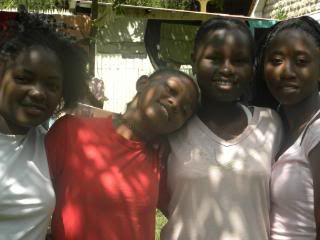
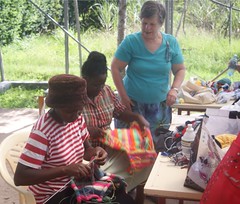
When I was in Kenya recently, one of the biggest delights was sitting with several Kenyan women just chatting as I taught them how to use knitting machines to start a micro business. (Here's my mother with two of our "students"). One woman, who had been rescued from the street when she was 10, and was now a married mom, asked me what we "plant" here in Canada. She wanted to know what crops my husband and I grow, because in Kenya, that's the main thing. Everyone grows something, and one's crops determine one's wealth. It's inconceivable that one wouldn't grow crops.
I explained the kind of crops that grow in my area of Ontario, without going into detail that the only crop I actually grow rather well is dandelions.
Another shocker from our first trip to Africa was how expensive sanitary pads are. They run about the same price as they do here, with the only difference being that there people only make about $1 a day. If you made $1 a day, could you afford pads? Probably not. And that's why many Third World girls and women miss a week of school and work every month because they literally have nothing to use.
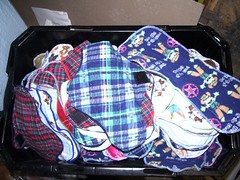
One of my pet projects in Africa was showing the women how to sew sanitary pads out of rags (and fabric scraps from their sewing school). We got quite good at them!
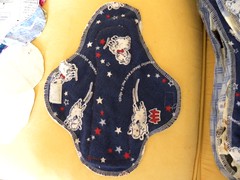
They're just flannel on top, two layers of towel (or four layers of flannel) in the middle, and then fleece on the bottom. Here's another one:
Kind of cute, aren't they?
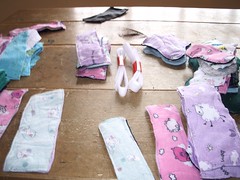
Here's a stack all cut out and ready to go on the sewing table at the orphanage. They just loved them (although everyone acknowledged they're a pain to wash). But women have been washing them for centuries, and they'll figure it out.
It's a little thing, sanitary pads. We take them for granted. But that just shows how rich we really are!
I know many of you are struggling with money right now. Remember, though, that we have been given so much here, and no matter how bad things get, God has still given us so many blessings. If you're burdened with worry today, think of these girls in Africa, so thrilled just from a little piece of flannel. We have much to be grateful for, and remember that this, too, shall pass.
When God decides to change the world through one person, He rarely tells someone: "you are now going to change the world." He usually just says, "pick up the phone and call someone". "Feed someone". "Do this one thing."
I've been thinking about that recently with my trip to Kenya. Charles Mully, who started the Mulli Children's Family 20 years ago, has an amazing story. You can read the whole thing in the book Father to the Fatherless (which I highly recommend), but let me summarize. When Charles was 6 his family abandoned him. They moved in the middle of the night, and when he awoke, they were gone. He tried to feed himself by going to neighbours and grandparents, but they had no extra food, either. So he fended for himself.
At age 18 he made his way to Nairobi, where he got a menial job for a family. The wife was impressed with him, and asked her husband to hire him in his company. He started at the bottom, and began to save money. Soon he had enough to buy a bicycle, and started a delivery service. After this he bought a van that became a taxi. Then he bought another. Then another. Soon he had a fleet of buses, and he was the sole representative for Firestone tires in Kenya. He had a business empire, and he was very wealthy in his 40s.
He had 8 biological children who went to good schools. He had three homes and two Mercedes. Then one day, on a trip to Nairobi, some street kids offered to look after his Mercedes while he went into a meeting. He refused. When he came out, the Mercedes was gone.
He couldn't get those kids out of his mind, because he knew that he had been a street kid himself, too. And three years later, he felt God clearly telling him to sell everything to look after these children.
So after a long struggle, he did. He started bringing kids in from the street, and they shared his biological children's bedrooms. Eventually he had too many and he had to build a bigger complex. His money began to run out, but foreign donors found out about him.
He began a process of working towards self-sustainability. Today his home has about 1500 kids that live their permanently, and 500 day children in other locations. He has a huge farm which provides about 50% of their food, and which also exports french beans to the Netherlands for cash. They have a fish farm and a poultry farm to provide the kids with protein, but also to sell to hotels in Nairobi for money. They employ about 500 local women working on the farms, and give out emergency food relief to the community. They have one of the top schools in the country, and their karate team is the reigning East Africa champions. They are starting a microbusiness program to help girls who have been rescued from the sex trade learn a valuable skill and then start a cooperative business together.
And right now they're working on a water treatment plant that will let their kids have clean bathing water (they already have clean drinking water), but will also provide clean drinking water to the community.
It's an amazing enterprise, and it keeps growing. But I don't think he had all these plans in his head the moment he began taking kids in off the street. God just asked him to do it, and Charles did.
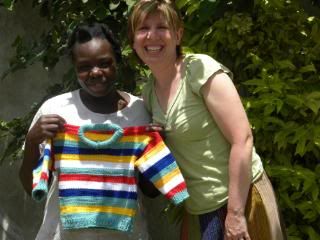
I got to know Lilian while I was there. She's 30 years old now, and married with several children. She works as a cook at the home, and her husband is a carpenter. We taught her how to use the knitting machine, and she's a riot! Here's the sweater she knit:
But best of all, she was the first girl that Charles rescued, all those years ago. She's doing so well now. Charles took her in, and he didn't know it would lead to all the rest. God doesn't tell you all the plan all at once. He just asks you to do what you can at the time, and it grows from there.
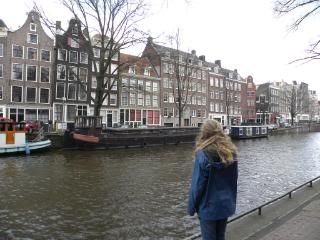
On our way home from Nairobi we had a six hour stopover in Amsterdam, and Rebecca, my 15-year-old, and I decided to take the train into the city to see the Anne Frank House. You can't take pictures inside the house, but we actually walked through the bookcase that hid their annex, and I stook in Anne's room. I saw all the clippings of film stars with which she adorned her walls. I saw the pencil marks in the living room marking how Anne and Margot grew over the two years that they were hidden.
It's a tragedy that she died, but a miracle what has happened with her diary, and how her story has touched so many. But her story was only possible because four Dutch people decided to risk their lives and help them. They sent food to them. One man provided Anne with film star magazines every week. Miep helped Margot take a correspondence course in Latin. Such little things to help a family make life bearable, but they did it. Miep was an amazing woman; she died recently, and I saw this video of her on YouTube (click on the bottom right for subtitles):
She probably didn't think she was changing the world, but she was. By keeping the Frank family hidden for that long, Anne was able to write her diary. And now look what has happened.
And then I read the story of Jaime Escalante last week. He's the teacher from the movie Stand and Deliver, who quit an important job to teach calculus in an inner-city LA school. He had enormous opposition, but he did such an amazing job that many kids who would otherwise not have had a future went on to win scholarships to universities. Eventually he was TOO successful, and the teacher's union kicked him out because he was willing to take on classes with too many kids and teach harder subjects than they wanted him to. But for those few kids, he changed their lives.
He was just doing what he knew how to do. He was using what God had given him. And he made an impact.
Charles Mulli, Miep Gies, Jaime Escalante. They changed the world not because they woke up one day and said, "today I will make a huge difference", but simply because they walked in obedience in the little things, and God multiplied them.
My mind is full of these three today, and I wonder what "little things" God is asking me to do. Perhaps I should spend more time listening, because you never know how God wants to use what He has already given you.
Every Friday my syndicated column appears in a bunch of newspapers in southeastern Ontario. Here's this week's!
Last week I came down with an *ahem* bladder infection. For those of you who have never experienced such a thing, imagine consuming four Obesity-R-Us sized pops at your favourite fast food joint, and then hitting the road to Niagara Falls, where you stop to take a scenic tour, all without bothering to relieve yourself. When you have a bladder infection, that’s how you feel. All the time.
It hit me late one night, rendering sleep impossible. After tossing and turning for several hours, I decided to head to the ER before dawn to beat the rush.
There I reported in to triage, where they made me—you guessed it—pee in a cup. I tried to explain to the nurse that peeing is what hurts, but to no avail. Then I sat in the waiting room with a decade’s worth of Golf Digest magazines, for two hours, to get the full ER experience.
When the doctor finally saw me he asked if I had been experiencing any fever. That was when I made my major tactical blunder. I told him the truth. I admitted that in my night of not sleeping, I had suffered quite bad chills, followed by sweats, which unfortunately bears a remarkable resemblance to a fever.
None of this would have been so bad except that we had returned from a three week trip to a Kenyan orphanage (more on that in an upcoming column). This caused this doctor, and my husband (who is also a doctor, and who had by this time joined me), to run around in circles shouting, “Malaria!!!!” Okay, maybe I’m exaggerating, but it’s important to make them look silly because I’m bitter.
I valiantly attempted to argue that it was a bit of a coincidence that malaria and a bladder infection should hit me at exactly the same hour, and that perhaps this wasn’t malaria at all, but they were unmoved. Seems doctors are more committed to “science” than to “women’s intuition”.
Now malaria is not nice. It causes you to have fevers, and chills, and nausea, and sometimes death. And then it recurs. Well, not if you suffered the death part, but otherwise it tends to pop up every now and then.
Therefore, it was decided that along with the typical blood work, which consisted of taking eighteen vials out of both arms, I should also be tested for malaria. And thus began my entry into the “Voodoo Doll Impersonation Contest”, for to find malaria, one blood test is not sufficient. Three are needed in the space of twenty-four hours, although I was poked far more than that because my veins started collapsing in protest.
Protest seems to be a natural reaction to almost everything that occurs in a hospital. It’s just not a fun place. The ER is covered with signs telling you how coarse and abusive language will not be tolerated, but I sometimes wonder if hospital administrators realize that normal people probably wouldn’t curse as much if you didn’t make them wait for hours, and then keep them in a hall with no privacy, and then tell their loved ones they have to stay out in the waiting room. It’s rather inhumane.
Sleep is downright impossible in a hospital, too, with all the bright lights and the constant chatter on the overhead speaker. If you’re sick, a hospital is the last place you want to stay. Most of us could recover much better in bed, where you could actually get some shut eye.
So that’s where I headed, after all my treatment was complete. And I realized that, as much of a pain as it was, after being in Kenya I am infinitely grateful that we have a hospital with experienced nurses and good and careful doctors. Even if they do err on the cautious side.
Don't miss a Reality Check! Sign up to receive it FREE in your inbox every week!
I'm having a very hard time writing about my trip to Kenya because it's so hard to summarize. So I think instead I'll give you a few snippets, rather than trying to give you all my thoughts at once.
1. The real problem in Africa is not AIDS. It's poverty and family breakdown. Sure AIDS plays a part, but if people had food and good nutrition, things wouldn't be nearly as bad. In the children's home where we worked, the percentage that were HIV positive was actually very low. But all came from horrific backgrounds. Some had been sold into sex work at the age of 8 or 9 by desperate relatives (including mothers). Some had been orphaned, and then seen their aunts and uncles come and take all the furniture out of the house, leaving them with absolutely nothing. We got to know one family of three biological sisters who were orphaned at ages 9, 5 and 3. The 9-year-old somehow found food for the other two for a year before the three were rescued. They had no furniture or cooking ware in their house.
Other children were tossed aside when their mothers died, and the father's other wives didn't want them. While Kenya is not a primarily polygamous country, there still is polygamy, and it wreaks havoc wherever it goes.
Our team was primarily a medical one. We had five doctors, six nurses, two pharmacists, and a dentist, along with the rest of us who were doing other things. The medical side saw 1,200 patients from the community, some of whom had walked upwards of 50 kilometres to get there. And the primary complaint? Typhoid. Waterborne illnesses. If we could just get clean water to people, we could give them such a better quality of life.
Almost everyone there suffered from headaches, fevers, and aches and pains all the time. It was relentless. Add in typhoid, malaria, and parasites, and they just come to expect it. Can you imagine living like that? The children's home has a water treatment plant that's 98% ready, so probably the next medical team won't encounter the same problems. But all over Africa, water is still the number one problem. And until we solve the water issue, the AIDS issue doesn't seem to really matter.
I'm not trying to discount it, it's just that in terms of severity, AIDS was way down the list. Let's get people food and water, and then we can start worrying about it.
2. Beauty is magnified in Africa. The people are beautiful. The singing is beautiful. The land, even with its cactus and thorns, is beautiful. The animals are beautiful. And perhaps because you live more outdoors and you're not connected to a computer, you experience and appreciate that beauty in a way that we can't in our busy lives.
3. Things are much slower there. I went with the expectation that I would get X, Y, and Z done. But things don't move according to my agenda. They value people much more than accomplishments, and they'd rather sit and talk to you than do something that you think is important. Rather than get frustrated, I learned how to talk and enjoy people with no agenda. It was actually quite freeing.
What I was involved in was teaching some of the women how to use the 30 knitting machines we brought with us so they can knit sweaters for the kids and then sell some. It actually does get quite cool sometimes, and they wear sweaters even when we would be in T-shirts, so it is needed. And we had such a great time teaching some of the kids to knit by hand, too. Some of them had been taught by mothers and grandmothers now dead, and it was a way to honour something from their past. Plus it was awfully fun!
4. Kenya has such potential. One girl in particular really stands out to me. She's in grade 12, and she wants to be a doctor. Her marks are excellent. I'm hoping to support her so she has the money to go to school. She's a natural leader, and leads worship at church. But she came from a very poor family who were subsistence farmers. When her parents died, she was beaten by relatives and neighbours as she came begging for food.
It makes me think: how many other geniuses is the world missing out on, as they live in slums, or perish in land without water? Many of these children are so bright, but they never had a chance to go to school until they ended up at the home. How can the world improve when we are wasting so much talent?
5. Holding a child who was left in a ditch to die at 3 weeks of age, and is now a thriving seven year old who can read and has memorized Bible verses and runs and smiles and plays is an amazing experience. Hugging a child who is 2 and who has survived her house being burned down while her mother did not, and feeling her peace, is so calming. It reassures you that no matter how dark life can get, God does not leave you. He snatched these children out of the worst circumstances and brought them to a place with great light. And we would say that these kids will never recover from their psychological wounds, and yet I have seen adults who grew up there as children who are now doing well--they're married, they have jobs, they're happy.
Perhaps we don't recover from traumas because we're too focused on them. These kids don't focus on the past--they focus on opportunities. They work hard at education, they make new friends, they learn to love God, and somehow the hurts fade. It's a good lesson.
6. Africa has a very different way of looking at family than we do. The British upper class, for instance, has always sent their children away to boarding school, as young as 7. I could never do that. I just couldn't. But in Africa it's very common for families to live apart from one another. Husbands go to far off cities to find work, and are there for six months or a year at a time (no wonder AIDS spreads. They sleep with prostitutes and then come home and give it to their wives). Kids go off to high school in a different city. It seems quite normal to raise children away from married, biological parents on a daily basis.
In some ways this is just a cultural thing (and an economic thing), no different from Britain last century. But I don't think it's healthy. I think Africa needs strong families. Churches need to encourage people to actually live together. It's hard, because you don't want to lose your ancestral land if you go to the city for work, but it's not healthy what's happening. And I do think kids need to know their parents. But perhaps it's just me being judgmental.
7. I'm left with the thought that this is not real life--this thing that I do. This playing on the computer and figuring out what to wear each day and taking the car in for an oil change and planning vacations. It's all fun, and it's all part of my daily routine, but life is so much bigger. The world is so much bigger. And we need to listen to God's whispers to take us out of our small lives and pay attention to that bigger one--the one around the world, the one around the corner, even the one that He is creating for us that we can't see yet. Each day is a gift, so let's spend time just appreciating it, and praying, and being still. Let's not get overwhelmed by the here and now. This is such a small part of God's creation, and He is doing so much in the world. I'm glad to realize again that the world does not rest on me--it rests on Him, and what He is doing. And that's so much better.
A week ago I read probably the most inspiring story I have ever seen on the internet. Seriously.
Teenager William Kamkwamba from Malawi quit school at 14 because his family could not afford the school fees. You can read the story here, but let me summarize.
He lived in a tiny village of a few dozen families, all of whom existed on subsistence agriculture. They had no electricity, and so everybody went to bed with the sun, at 7.
Being a typical teenager, he was bored. He didn't want to go to bed at 7. He wanted to stay up and read. So one day he walked to a nearby village that had a library, and he found two books that interested him: one was on electricity, and one was on physics or something. The electricity book had a picture of all these windmills on the front cover, and after reading the books, he decided to build himself a windmill so that he could power a lightbulb so he could read at night.
And over the next two months, this 14-year-old boy built a windmill. He collected parts from wherever he could find them, and the part that actually turned the windmill was from an old bicycle. In the article, they describe his foraging and design this way:
He then attached the long plastic blades to the shorter metal blades of a large tractor fan found in a dumpyard, and stripped out the piston from a large shock absorber to serve as the windmill shaft. To secure the plastic blades to the metal ones, he used proper nuts and bolts. But standing in for washers were 16 Carlsberg beer bottle caps, collected from outside the Ofesi Boozing Centre.
The dynamo, connected to a hand-crafted transformer, was sufficient to power a 12-volt battery that fed a current to a small light in his bedroom, where he fashioned an outlet and push button wall switch using the AC socket from a radio, copper wire, a plastic wall mount made from flattened PVC pipe and parts from a rubber flip-flop.
Necessity, as they always say, is the mother of invention.
That was a few years ago. He has since made two more windmills, enough to light several lightbulbs in their house, power their radio, but most importantly, power their water pump so they can irrigate their fields. They've now planted more and different crops, and the village is prospering. And it has a happy story for William himself. There's a great video at the site, too. You really need to see it.
What did all of this teach me? It told me that when you have a teen who is sufficiently motivated, has time on his or her hands, and has access to information, he or she can do basically anything.
But we need those three things: motivation + time + information.
Do our kids have that?
Let's start with motivation. I'm a firm believer in the importance of motivation. I think it's more important than raw intelligence in terms of whether or not a person will succeed in life. But children won't have motivation if everything in their lives is given to them with little effort. They have to be encouraged to try, and see the rewards at the other end. They have to learn the value of hard work, and that means that not everything in their lives can be easy.
What about time? This kid built a windmill because he had nothing else to do. He was working at his father's fields, but that didn't take that much time. And he didn't have to go to school. Our children don't have much down time anymore. We fill their lives with lessons and play dates and homework and activities, and so it's little wonder that children fail to explore. Most of the great inventors, composers, and thinkers had lots of spare time. We need to build "nothing" into our children's schedules, even if that means cancelling lessons.
But one of the best ways to build "nothing" in is to turn off the television. When kids are too invested in technology or video games, they don't have time. So limit technology if you want your children's brains to fly.
Finally, we come to information. That's one thing our kids do have in abundance. William, after he built his windmills, was discovered by some journalists and eventually flown to the U.S. to see windmill farms in action and go on a speaking tour. While there, he was exposed to the internet for the first time. Now he wants to bring electricity into all these villages just so people can get on the internet. Imagine how much easier it would have been for him to build his windmill if he had had the internet! As it was, he had no plans. He just had pictures he tried to copy. It worked, but he was amazed at what was out there on the world wide web.
Our kids have the information. They have more information more easily than at any other time in history. It is a shame, a tragedy, a crime that they don't also have motivation and time. Imagine what this generation could do if they did!
My family and I have been to the Mulli Children's Family Home in Kenya several times. It's been a life changing experience for my daughters (and for me), and it's been so humbling. My husband has done medical work there, and my mother and I have organized all the donations and giving them out, along with helping with the microbusiness projects for the teenage girls who have been rescued from prostitution. We're in the middle of starting a knitting program for them (we've sent over several dozen knitting machines), and I'm excited about that!
But one thing that we have brought over is bras. Tons and tons of bras. Several thousand each time. There's a factory near us that makes high-end mastectomy bras (which work fine even if you haven't had a mastectomy), and they give us for free all their seconds. Add the donations to that, and we get a LOT of bras.
This morning my girls and several girls from our youth group sorted another 1000 donations. We don't bring too many of the 48DDs, for obvious reasons. The 36As and 34Bs are more useful. So because of space considerations, we sort everything so that we prioritize the small ones. So in two hours we bagged, counted, and sorted about 1000 bras.
Here's my girls and I sorting in Africa a few years ago:
And yes, Katie likes to put the huge ones on. She thinks it's funny.
It seems silly sometimes, but I'm reminded of one episode the first year we did this. We laid out all the bras on benches, in sizes, like this:
In the picture a teacher is trying a bra on. I can't show you pictures of the girls, for privacy reasons, but you get the idea! They like to try them on over their T-shirts to make it easier, and we all joined in:
That particular day one of the teachers came over and grabbed a big one and asked if she could take it for a girl who was too shy to try it on. She was large, and she was self-conscious about it. We said of course.
She came back and said that it fit the girl perfectly. If I remember correctly, it was something like a 38FF. We figured she'd probably never have a chance to get something like this again, and when you're that size, you need it. So we told her to go ahead and take a second for the girl.
Later that day, after everyone left, a very shy girl came in and gave my mother a kiss. It was the first bra she had ever found that had fit, and the first thing she'd ever worn that was new.
These girls have mostly been rescued from prostitution, or from prison (where they go when they are homeless) where they are gang raped. Most arrive pregnant, or with babies already. They are 15-20. They rarely have any underwear. To give them bras and underwear is just to give them some modesty after the abuse they have suffered. They really appreciate it.
Sometimes when we are swimming in bra donations the whole episode seems almost surreal. And sorting bras with a bunch of teenage girls is a riot! But what seems just silly and funny to us here makes such a difference there. And so I'm glad I had a chance to share that with my girls this morning, and I'm sure we'll sort many more before we return to Africa, with this next batch, in March!
I just got dinner ready. Rinsed off the potatoes, peeled them, rinsed them off again. I washed the broccoli and carrots and filled the steamer to cook them. Added water to the potatoes and put them on the stove.
Before dinner we played tennis. Came home, and four of us had showers. While we were there we were drinking bottled water.
Just like any other day. We don't even think about water, do we? But what would we do if we couldn't turn on the taps?
I live in Ontario, Canada. We're surrounded by huge rivers, amazing lakes for cottages, and water everywhere. We often bike down to the waterfront to eat our lunch. In the spring, we run the risk of flooding. I can't imagine a place in the world with more clean, fresh drinking water.
In Kenya, at the orphanage where we often travel (and where we're leading a medical team next March) they're currently in water crisis. The orphanage is home to almost 1000 kids, and the river has run dry. The kids bathe in the river, but they have a well for drinking water. The well is almost out.
You can't ship water. It's really expensive, and it evaporates, and all kinds of problems. At the orphanage they have all kinds of methods of collecting and saving water. If the rain ever came, even a few milimeters, they'd be okay. But there's been no rain.
They'll probably do a big fundraising drive soon for $100,000 to drill four more bore holes for deeper wells that can supply them and the village, and I'll kick in a bunch, and I'm sure they'll raise the money.
But I just can't imagine living worrying about water. We are so, so blessed. We're blessed with so many things, but water is the basis for everything, isn't it? Can you imagine relying on a river for your drinking water and your washing water, and then watching that river run dry? I guess our ancestors dealt with that frequently, at least in the midwestern states, but it's so beyond my consciousness, and yet that's what so much of the world deals with.
Tonight I'll probably take a bubble bath. I love bubble baths. We might install a hot tub later in the summer. But before that, I think I'll give a bunch of money to drill them some bore holes. I wish I could ship them our Moira River, but I can't. Life sometimes just isn't fair, and it makes me sad.
Yesterday I had six women and five teenage girls over making the craft project to end all craft projects.
I've posted before about the cloth sanitary pads that we make and send to Africa. A friend who runs Heart to Africa in Georgia emailed me and asked if I could send her a bunch to go to a women's prison in Kenya. Right now, when it's that time of the month, the girls just squat over a bucket for a week. They have absolutely nothing. Can you imagine?
So we made her 160 (2 for each girl) and I mailed them off today. That's not enough, and washing them in prison is going to be tough, but it's better than nothing I suppose. Personally, I think these will work better for those living on their own, even just in huts, where they can wash with river water or something (because you need a lot of rinsing), but at least this is a start.
My daughters are always joking about my "craft" project, because I get so excited whenever anyone gives me old pyjamas or old fleece! But they jump in and help all the same.
Here they all are at the end of the day:
And here's a video we made last time:
It's on my list of things to do this summer to publish a pattern and a video so you can make them, too, either for your own use (they're very comfortable) or to send overseas.
But if you have any questions or comments, just leave them below!
Across Canada, starting today, World Vision is hosting the 30 Hour Famine.
And what is the famine? Teens choose not to eat for 30 hours and then get pledges to raise money for World Vision.
My daughter and my nephew are participating in this, and they're really excited (though they're about to eat a whole ton of waffles for breakfast to get them ready)!
Africa has touched Rebecca. We've visited an African orphanage there twice, and it made such a difference in the way she sees the world, and her compassion for others. I've had to really teach her to save her money recently because she's so prone to donating all of it away. I guess that sounds like I'm bragging (perhaps I am), but I'm just very proud of her.
Most kids haven't been to Africa, but the Famine is such a wonderful idea because it gets the kids thinking about what they have here in North America. And it gives them an inkling, if only for a few hours, about a part of what these kids go through.
Of course it's not the whole story, and Rebecca knows that. The childen she met in Africa weren't just hungry; they were also abused, and abandoned, and scared, and alone before they were rescued. Many had been without food for days, too, but during those days they'd also had to walk miles and miles to a different town, looking for work. They had to use energy. It truly is heartbreaking.
The whole thing starts at noon today, and if you live in Canada and want to donate, even $5, you can do so online securely right here. I know Rebecca would really appreciate it!
And in the meantime, I'm going to watch her try to fast! Starting tonight she'll be at our church, playing games, watching videos about poverty, and talking about the world's needs. We'll pick her up tomorrow night. I hope she makes it!
I have written before about the Mulli Children's Family, an orphanage in Kenya where my family and I have travelled, and where my mother is now.
Remember the pad party video that I posted a while ago? That was all to benefit these girls in the orphanage.
Anyway, my mother is on the board of the charitable foundation in Canada that raises money to help the orphanage, and she sent an update over the weekend of what she's seen. For reference, the Mulli Children's Home is located east of Nairobi, but up north, in Eldoret, there's a refugee camp that started after all the violence in that country a year ago. The orphanage was instrumental in starting relief work there, feeding 3000 people a day and setting up an impromptu school for 1000 children. Three hundred teenage girls were taken from the camp to live at the orphanage, because many had been repeatedly gang raped each night. That was a year ago; they now have several hundred babies at the orphanage, too.
MCF, the orphanage, is doing very well because they believe in self-sufficiency. They've started an elaborate farm and greenhouse operation that feeds the thousands of people there almost entirely, and exports to Europe to bring in cash. They have a fish farm, and a meat farm, and they have a construction company and they start small businesses. It's quite the enterprise, and it's entirely Kenyan run. They don't just take donations from the West for food; they take donations really to build their infrastructure so that one day they will not need donations. And it's working really, really well.
But in the meantime, the need is just so great. My mother sounds very burdened after seeing it all. Here's a bit of what she wrote:
We are all safe and sound but heartbroken...Somewhere this week we flew to Eldoret. MCFCF had raised considerable funds for emergency relief in the IDP Camp and we felt part of our audit should include seeing the site and facilities. There are still about 3500 people living there although the camp was officially closed last July. MCF pulled out in December because they had run out of all funds. As we arrived and starting walking about the camp people gathered. Mueni Mulli was accompanying us, but they also had the MCF Pastor who spent the last 5 months in the camp with us.
We were walking about and one or two women invited us into their tent and told us their story. Richard was able to video this which will help in telling the story, but you cannot imagine the hardship these people are facing. They have not had food since MCF pulled out in mid December other than what the children are able to beg on the streets of Eldoret during the day - and it is a long walk from the IDP Camp to town.
One woman came up to me and asked if we could help her neighbour. The woman had given birth two days ago and neither she nor the baby had anything to eat or drink since nor did she have any help. I told Mueni and she and the pastor went to visit the tent. Apparently Richard got a photo so we can tell the story. Later Mueni explained that she would give the Pastor some money to buy some food for the most desparate situations we encountered, but we all know this is not a solution. Nor can you ignore the reality of the situation. What to do.
The absolute irony (I am not sure that is the right word) of the situation is that, after returning to Nairobi and showering, we took the Mulli family out to dinner that evening. We had a wonderful time with them and heard more about the challenges MCF is facing, but what a contrast!
When we think of the economic hardship we are going through here in North America, it really does not compare. Imagine having to live in a tent, and having no way to protect your teenage daughter from rape. Imagine giving birth all alone, and not having any food.
We are suffering now because as a society we spent what we had frivolously. How much better if we could share what we have with those who need it, in ways that it will actually get to the people who need it (and not go to corrupt governments!). Despite the grim economic news, I am reminded today how much we do have, and how grateful I am for what God has given me. And as soon as my mother gets back, we'll start another round of fundraising, selling all the neat African stuff she's importing! I'm excited.
For several years my family has travelled back and forth to the Mulli Children's Family in Kenya, a children's home to over 800 abandoned and orphaned children. We just love it there, and my kids have made some good friends.
But one thing that is desperately needed for all those teenage girls and adult women is sanitary supplies. Disposables, like we use, are too expensive. And they have little else. Often women just stay home when they're having their periods, missing school and work.
The Children's Home has tried desperately to supply everybody with pads, but with over 300 teenage girls, it's hard.
So yesterday, I hosted a sewing party for pads! We had a great time. Watch this video; it's only 1 1/2 minutes long, and you'll get the picture!
Every week I write a syndicated parenting column that appears in newspapers across Canada and a few in the U.S. Here is this week's: Kindness Is as Kindness Does
In our homeschool lately we have been trying to sum up famous people by their best-known sayings. “I have a dream!” (Martin Luther King Jr.). “The only thing we have to fear is fear itself.” (Franklin Roosevelt). “Mr. Gorbachev, tear down this wall!” (Ronald Reagan). “The buck stops here.” (Harry Truman). Some presidents we remember because of the stupid things they said—“Read my lips,” by George Bush Sr., or “I did not have sexual relations with that woman,” by Bill Clinton. We didn’t actually study the latter, of course, since it’s not very child-friendly, but you get the point.
Those comments all resonated, whether good or bad, because they reinforced who we already knew those figures were. Martin Luther King was a visionary. Franklin Roosevelt was a courageous leader. Ronald Reagan believed in freedom. Harry Truman took responsibility for his difficult decisions. George Bush Sr. waffled too much. And Bill Clinton was Bill Clinton.
How will people sum up my life? I was mulling this over recently when I heard that my mother had been named the Kindest Person of the Year in our hometown. She learned of this award through a phone call, which she initially suspected was a hoax. When she realized it wasn’t, though, she protested, “But I’m not that kind!”
My mother has been organizing a career centre for a group of unionized employees who have been laid off. She’s gone above and beyond to lobby for extra training and opportunities for them, and they rewarded her by submitting her name. They weren’t just impressed with what she did for them, though. They were impressed by the stories they kept hearing about her African exploits.
Three years ago my mother visited the Mulli Children’s Family in Kenya for the first time. Home to over 800 children and teens, Charles Mulli, the Kenyan founder, works to give these kids a top-notch education and job training, along with support and love. The first team my mother was a part of included a filmmaker, several pharmacists, and lots of others with useful skills. Mom was at a loss as to what she could contribute. After pondering for a while, I suggested she teach some girls to knit. After all, yarn isn’t heavy, so you can take an awful lot in your suitcases.
She thought it was farfetched, but she let the word get out that we were collecting yarn. Within three weeks her entire living and dining room were filled with Wal-Mart castoffs. Since then she’s traveled to Kenya three times, twice with me and the family in tow. We have also delivered thirty knitting machines, so that several graduates can set up a knitting business for income.
It’s not only yarn that we stuff in the suitcases, though. The first time Mom was over she also realized the need for underwear and bras. Many of the girls arrive at the home after being severely abused on the streets. Providing them with undergarments gives them some much-desired modesty. So we let the word out that we wanted bras, too. Last summer we brought over 4000. Some were lacy. Some were functional. And some were just plain odd. We even had a 48DD bra that was an add-a-cup, the kind with extra padding to make one look bigger. And bras and yarn keep pouring in, almost squeezing my mother out of her house.
I think my mother is one of those people who has done amazing things without realizing it. She saw a need and did the small things that she was able to do. And those small things grew, and grew, until they became too big for her to manage. She grew discouraged. She wondered if there was a point. But she perseveres.
She accomplishes much with what she has, because these actions flow out of who she is and who she is becoming. And isn’t that the point? Life isn’t about tooting our own horns. It’s about doing what we can with what we’ve been given. To my mother that’s nothing to be proud of; we all should be doing that, so what’s the big deal? “I’m not that kind,” she says, because she doesn’t think she’s doing anything special. I disagree. And I would be proud to follow in her footsteps.
Don't miss a Reality Check! Sign up here to receive it in your inbox every week.
About Me: I'm a Christian author of a bunch of books, and a frequent speaker to women's groups and marriage conferences. Best of all, I love homeschooling my daughters, Rebecca and Katie. And I love to knit. Preferably simultaneously.
















 Stumble It!