When God decides to change the world through one person, He rarely tells someone: "you are now going to change the world." He usually just says, "pick up the phone and call someone". "Feed someone". "Do this one thing."
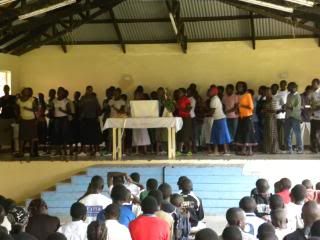
I've been thinking about that recently with my trip to Kenya. Charles Mully, who started the Mulli Children's Family 20 years ago, has an amazing story. You can read the whole thing in the book Father to the Fatherless (which I highly recommend), but let me summarize. When Charles was 6 his family abandoned him. They moved in the middle of the night, and when he awoke, they were gone. He tried to feed himself by going to neighbours and grandparents, but they had no extra food, either. So he fended for himself.
At age 18 he made his way to Nairobi, where he got a menial job for a family. The wife was impressed with him, and asked her husband to hire him in his company. He started at the bottom, and began to save money. Soon he had enough to buy a bicycle, and started a delivery service. After this he bought a van that became a taxi. Then he bought another. Then another. Soon he had a fleet of buses, and he was the sole representative for Firestone tires in Kenya. He had a business empire, and he was very wealthy in his 40s.
He had 8 biological children who went to good schools. He had three homes and two Mercedes. Then one day, on a trip to Nairobi, some street kids offered to look after his Mercedes while he went into a meeting. He refused. When he came out, the Mercedes was gone.
He couldn't get those kids out of his mind, because he knew that he had been a street kid himself, too. And three years later, he felt God clearly telling him to sell everything to look after these children.
So after a long struggle, he did. He started bringing kids in from the street, and they shared his biological children's bedrooms. Eventually he had too many and he had to build a bigger complex. His money began to run out, but foreign donors found out about him.
He began a process of working towards self-sustainability. Today his home has about 1500 kids that live their permanently, and 500 day children in other locations. He has a huge farm which provides about 50% of their food, and which also exports french beans to the Netherlands for cash. They have a fish farm and a poultry farm to provide the kids with protein, but also to sell to hotels in Nairobi for money. They employ about 500 local women working on the farms, and give out emergency food relief to the community. They have one of the top schools in the country, and their karate team is the reigning East Africa champions. They are starting a microbusiness program to help girls who have been rescued from the sex trade learn a valuable skill and then start a cooperative business together.
And right now they're working on a water treatment plant that will let their kids have clean bathing water (they already have clean drinking water), but will also provide clean drinking water to the community.
It's an amazing enterprise, and it keeps growing. But I don't think he had all these plans in his head the moment he began taking kids in off the street. God just asked him to do it, and Charles did.
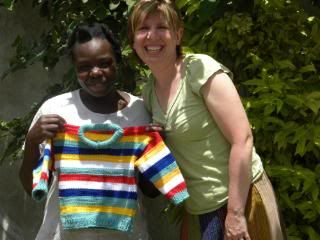
I got to know Lilian while I was there. She's 30 years old now, and married with several children. She works as a cook at the home, and her husband is a carpenter. We taught her how to use the knitting machine, and she's a riot! Here's the sweater she knit:
But best of all, she was the first girl that Charles rescued, all those years ago. She's doing so well now. Charles took her in, and he didn't know it would lead to all the rest. God doesn't tell you all the plan all at once. He just asks you to do what you can at the time, and it grows from there.
On our way home from Nairobi we had a six hour stopover in Amsterdam, and Rebecca, my 15-year-old, and I decided to take the train into the city to see the Anne Frank House. You can't take pictures inside the house, but we actually walked through the bookcase that hid their annex, and I stook in Anne's room. I saw all the clippings of film stars with which she adorned her walls. I saw the pencil marks in the living room marking how Anne and Margot grew over the two years that they were hidden.
It's a tragedy that she died, but a miracle what has happened with her diary, and how her story has touched so many. But her story was only possible because four Dutch people decided to risk their lives and help them. They sent food to them. One man provided Anne with film star magazines every week. Miep helped Margot take a correspondence course in Latin. Such little things to help a family make life bearable, but they did it. Miep was an amazing woman; she died recently, and I saw this video of her on YouTube (click on the bottom right for subtitles):
She probably didn't think she was changing the world, but she was. By keeping the Frank family hidden for that long, Anne was able to write her diary. And now look what has happened.
And then I read the story of Jaime Escalante last week. He's the teacher from the movie Stand and Deliver, who quit an important job to teach calculus in an inner-city LA school. He had enormous opposition, but he did such an amazing job that many kids who would otherwise not have had a future went on to win scholarships to universities. Eventually he was TOO successful, and the teacher's union kicked him out because he was willing to take on classes with too many kids and teach harder subjects than they wanted him to. But for those few kids, he changed their lives.
He was just doing what he knew how to do. He was using what God had given him. And he made an impact.
Charles Mulli, Miep Gies, Jaime Escalante. They changed the world not because they woke up one day and said, "today I will make a huge difference", but simply because they walked in obedience in the little things, and God multiplied them.
My mind is full of these three today, and I wonder what "little things" God is asking me to do. Perhaps I should spend more time listening, because you never know how God wants to use what He has already given you.
I don’t mean chuck your family; I hope you all know me well enough for that. I mean chuck this daily grind that we live and do something completely wacky and outrageous.
I read this story about Lucy Buck, a producer on Big Brother who gave up her job and her life and moved to Uganda to start an orphanage. After my recent trip, I understand that rationale.
Today, two years on, Lucy has not only set up her own children's charity, named the Child's I Foundation, but is about to open the doors of her own orphanage in Kampala. An incredible achievement for a girl who is just 32 years old.
With the help of a team of enthusiastic volunteers, she has transformed a once derelict house in a quiet suburb of bustling Kampala, the capital of Uganda.
Where once bricks were exposed and plaster was crumbling, now, bright jungle and underwater-themed murals cover the walls.
In just a few weeks time these newly-painted rooms will become home to Lucy's first tiny wards.
People’s biggest need, I think, is to feel purposeful. We want to feel as if we were created for a purpose, and as if we are living out that purpose. It goes along with our need for God. Without God there can’t be purpose; everything has to be random. You can recreate your life to make it meaningful anyway, as many without faith have attempted, but in the end we want to feel as if we are connected to something larger. We need to know that there is a greater plan than the one that we can see.
And there are days when I wonder if what I’m doing is really the best use of the 80-odd years I’ve been given on this earth (or however many I end up having). So many in history have risked all to live a big life, and I have to admit being very tempted towards that calling.
A few years ago our family made the decision to move to Kenya for the year. We had saved up money so we wouldn’t need to ask for support; we had found someone to live in our house; we had even found where Keith wanted to work. We had arranged work for me to do. And then doors kept closing in our faces. I won’t go into the details, but the final nail in the coffin was when our acceptance package arrived from the missions organization—and it had been burned to a crisp. It was in a plastic bag, in ashes, our address the only thing visible, with a note from the post office that someone had set the mailbox on fire, and this was all that was left.
It was our “burning bush” experience, except the thing burning was paper.
I surveyed a bunch of friends to ask them what they thought it meant. Was it more opposition that we were just supposed to overcome? Was it a sign that we weren’t to go? Or was it a sign that we were to persevere?
A very wise friend said to me, “If God wanted to get your attention, how else could he do it? Are you really saying to God, ‘could you just be a little more subtle?’” I decided he was right. We were already feeling as if things weren’t working out, so we said no. I was heartbroken, because I so wanted my kids to experience life overseas.
Then four months later the violence broke out after the election in Kenya, and houses were burned, and life was chaotic. We would have been smack in the middle of it, and I’m sure my mother-in-law would have had a heart attack watching the news. It was easy, in retrospect, to see why God didn’t want us to go that year.
And yet I feel as if our chance passed us by. Now that the girls are teens they are much more attached to our church, and to friends. It’s harder to leave for a year, and I don’t think we’d have their support in the way we did then. I do plan on going for an extended time, but it will be after they have grown.
Thus I am back here, questioning again the point of my life. I find myself so attracted to stories of people who have given up everything to live a more important dream. Not all of these people have moved overseas; some have simply taken in a bunch of foster kids; others have given up good jobs so that they could start an inner city ministry. I know one couple who felt so burdened by the plight of prostitutes that they gave up their jobs and started a ministry helping prostitutes find another way to support themselves and get off of the streets. They live in the red light district in Toronto; they have sacrificed much, and yet they see what effect their work is having.
I was thinking about the story of Esther lately. In that story, the king allowed Haman to issue an order to kill all the Jews, and Mordecai wanted Esther, the queen, to intervene. When Esther wrote to Mordecai saying she didn’t know if she could help because the king could kill her, Mordecai said something interesting. He wrote back:
Do not think that because you are in the king's house you alone of all the Jews will escape. For if you remain silent at this time, relief and deliverance from the Jews will arise from another place, but you and your father's family will perish. And who knows but that you have come to royal position for such a time as this? (Esther 4:12-14)
I love that. It is not that God NEEDS us. If we don’t help, He will simply raise up help elsewhere. But He does want to use us. If we don’t step up to the plate, someone else will, but we will miss the blessings. How many blessings are we missing because we're content with a small life?
I am not saying that we all need to do something dramatic to be in God’s will. He may be calling you to be just where you are. But at times I feel that’s a copout.
There are 12,000,000 street children in Africa, and countless more in Asia and South America. There are hundreds of thousands of children in foster care and up for adoption in our continent. Who should take care of these children, except for Christians? If the church as a whole stood up and did its job, we wouldn’t have a foster care crisis. We wouldn’t have older kids who are eligibile for adoption languishing in the system because nobody wants them.
And yet am I willing to disrupt my family life to take any in? I’m not sure. I need to talk more to God about it. But if I’m not willing, who is? Why do we always assume someone else will?
I am in awe of Mary Ostyn, whom I interviewed recently, who has adopted many orphans from overseas, as well as some from here. Her love flows. Does mine?
Perhaps I am drawn to the dramatic out of a bit of pride. When you do something dramatic, you can “prove” that you love God, that you are a good person, that you make a difference. When your life is less dramatic, all those things may be equally true, but they’re not as evident. Perhaps I just want to be one that other people look at and swoon over me.
But I don’t think so. At heart, I think I want to help, I just can’t figure out how to do it. This world has so many needs, and I don’t think I should just be confined to raising my own children—as important as that task is. So I will keep praying, and keep talking, and keep thinking, until I feel a peace. Or until I see something else burning.
Today I want us to think about the word "home" in a different way.
And don't worry; I don't want you to get out a sledgehammer and knock anything down, unless you're really into that.
I just want us to get real about what keeps us cocooned in our homes.
There's a school of thought, especially among some Christian circles, that the home is so sacred that it needs at least one parent completely dedicated to that home--and that person should be the mom. I don't actually buy that. I think the KIDS are so sacred that they need at least one person dedicated to that, but I think we redefine family to mean "what occurs inside the walls of our homes". We don't want to get too busy because we don't want to endanger family time. And we want to make sure our homes run smoothly, so we spend an inordinate amount of time inside those four walls ensuring (or at least worrying) over exactly that.
In the meantime, though, I'm afraid too often that real life passes us by.
Yes, we need to have an organized home. Yes, we need to cut back on extra activities so that we have family time. But here's a more important question: what is the purpose of that family time? In my opinion, family time should be to foster relationships, transmit your values, have fun, and build love. But these things do not necessarily need to be done at home. And indeed, often they are best done outside the home.
Let me explain what I mean. God calls all of us to reach out to the poor, the lost, the brokenhearted. As my blogging friend Terry reminded me in this post, He doesn't give you a hall pass when you have kids at home. He doesn't say, "come back in twenty years when your kids are all grown, and you can serve me then." He says that we, as the church, need to be His hands and His feet.
But we also need to be moms. So can the two things go together? I think they can, but it means recognizing that home and family are not synonymous. Do you remember in Deuteronomy 6, when Moses had finished reading the Law to the people, and he was summing it up? He said, "you should put these laws on your foreheads and on your doorposts, and you should talk about them to your children when you get up and when you lie down, when you eat and when you walk along the road." (I'm doing this from memory, so that's my paraphrase).
In other words, we're to be transmitting to our kids the truth about God when we get up and when we lie down (at the beginning and end of the day), when we eat (at meals), and when we walk along the road (when we go places, engage in business, reach out). It's that walking along the road I want to focus on.
The best way to transmit our values to our kids is to have our kids see our values in action. It does no good to talk about the need to put God first in your life, or to share what you have with others, if you're not actually doing these things. The kids will see from what you do how much you actually value what you say.
But God wants us to walk along the road with our kids. He wants us to be engaged in the world WITH our kids. He doesn't want us to leave them behind so we can do our ministry (we're reading Floyd McClung's biography Living on the Devil's Doorstep right now, and McClung learned this the hard way), but He does want them involved in our ministry.
Last month, when we had the immense privilege of going to Africa for the third time, I saw how God worked in my kids' lives. Over the last two trips the girls got to know some of the children at the children's home we visited, and they continued those relationships now. They see what God is doing. And they helped, too. My youngest, whom I always have a difficult time getting to do chores, jumped in and mopped the floor for the medical clinic, where the doctors and nurses on our team were working, several times. And mopping the floor in Kenya involves getting down on your hands and knees and using a rag.
They helped mend clothes for orphans. They talked to kids and prayed with kids. They got involved in the choir. And my daughter Rebecca, who is 15, says that she can feel the Spirit there in such a special way because the kids are so open to worship and pray at any time.
When we talk about giving money now, and who should we donate to, they can put a face to the appeals. They want to help. And they're not as attached to all the "things" inside our home because they've been outside so much, and they've seen how the rest of the world lives.
Obviously visiting an African orphanage is outside the realm of possibility for most. I was very blessed to be able to do it. But my blogging buddy Terry goes to a homeless shelter with her whole family once a month. That's something we can all do. I know other families who work at a soup kitchen together, or who foster together (when you decide to foster, the whole family is being called!). Service, then, does not have to be something that takes you away from your family; it's a way to "walk along the road" with your children and involve them in real life. Involve them in the kind of activities you want them to continue to do when they're older.
So go clean up a park together. Adopt an immigrant family together. Volunteer together. We all want family time, and we want meaningful family time. But that time should not always be inside our four walls, where no one can get to us. God does not want us living within our four walls; He wants us to get refreshment from our homes so that we can walk along the road with others.
It's hard when children are very young, but I still believe there are ways to reach out, even if at that point in time it mostly involves bringing people into your home (inviting people for dinner, filling up food baskets or clothing baskets for those who need them). But service isn't something that we will do "once the kids are gone and I have more time". It's something that has to be an integral part of your life now. If it isn't, then what makes you think that your children will grow up to want to serve? They won't.
Family is our first responsibility, but training that family in the way it should go is the point, not making sure your house in its four walls runs perfectly. So don't sacrifice service for perfection. Reach out, even if it's messy. It will change your kids as you "walk along the road" with them.
I was 15 when the original We Are the World hit the airwaves. I think it was for Ethiopia at the time, was it not? It kind of escapes me now. But I remember thinking that it was an interesting idea, but I didn't know what kind of a dent it would make.
Now, 25 years later, they've recorded another "We are the World", this time for Haiti. And Michael Jackson's still in it, using footage from the original. If you haven't seen it, here it is:
My daughters have both been very active raising money for Haiti. We have a friend who runs an orphanage outside the capital city, and they've been overrun with refugees, so we've been helping to support them, sending money down.
So please understand, what follows is not mean to disparage anyone's fundraising efforts for Haiti. The country is in desperate straits.
No, what interests me more about this video is what struck me 25 years ago, too, as a teenager. Take a look at the words:
We are the world, We are the children, We are the ones who make a brighter day, So let's start giving.
It's a choice we're making, We're saving our own lives It's true we make a better day, Just you and me.
Okay, here's a grammar question: who is the subject in the majority of those phrases?
It's "we". The song is supposed to be about people who are suffering, but instead it's actually a song about how we feel about the people who are suffering, and how we can make a difference, and how we feel about the fact that we can make a difference. It's a song glorifying our generosity.
Does anyone else find that a bit jarring? First of all, we AREN'T the children. I think the point they're poetically trying to make is that those starving kids are no different from us, so we should really give. But what would it matter if they were different from us? Shouldn't we give anyway? No matter which way you look at it, the reference point in this song is US, not those who need help.
It's true we make a better day, just you and me. It's about you and me! We can sing about ourselves and feel better about ourselves because we care about others who are just like ourselves.
It's a perfect metaphor for what has happened in our society over the last few decades. As the idea of objective truth and objective morality have dissipated, it's been replaced by the ultimate idea that our feelings should now be an arbiter for the goodness or rightness of anything. Truth is what we feel truth to be. Truth is what feels right to us. Love is what feels right; if it doesn't feel right, it's not love, and we can give it up. We don't want to be judgmental, so what you want is fine and what I want is fine. Everybody should just get along, and decide on their own what they think is best.
At one point, people believed in a higher morality, even if they themselves weren't religious. You should do the right thing because it was the right thing. So people gave generously, or volunteered, or lent a hand, because it was the right thing to do. They didn't have to be convinced to do it because it would make them feel good about themselves; they did it simply because it was the right thing to do, and doing the right thing mattered to people.
We no longer believe in "the right thing" as much as we believe in "the right thing for me". I am the reference point, not the right thing. Everything revolves around me.
When Jesus makes His case for why we should help the poor, He says, "for as much as you did it to the least of these my brothers and sisters, you did it for Me." We should feed the poor because Jesus Himself identifies with the poor. He is the poor. When we feed them, we feed Him, because we care about what He cares about.
This song, on the other hand, doesn't identify God with the poor; it identifies US with the poor. God is no longer our main reference point; it is simply how we feel about things. We aren't then really honouring the poor in Haiti; we're actually diminishing their humanity by saying they aren't important in and of themselves; they're only important inasmuch as they remind us of ourselves. We can only have sympathy for those who are like us, because our world has been reduced to what we want and what we think, and it's no longer as wide and as big as it was when God was at the centre. When we are at the centre, the world is small. When God is at the centre, it's full of immense possibilities and dreams and futures and hopes.
It's amazing how we thought that in getting rid of God we could achieve more for humanity. It seems instead that we have become self-centred narcissists who exist to feel good about ourselves. Again, let me reiterate: I am glad that these artists are attempting to raise money and awareness of Haiti, and I hope and pray their efforts succeed. The fact that they have done it in this way, though, shows something rather disturbing. It's now all about us. And if it's all about us, and we decide that we really don't want to care, what's to stop us? If it's really about us, and we decide we don't want to stay married, or be bothered to be good parents, what's to stop us? If we are the only arbiters of truth, then what is the higher purpose of life, except for trying to feel better and better about ourselves? It seems like a rather empty life, and I hope that someday soon we may remember a better song:
About Me: I'm a Christian author of a bunch of books, and a frequent speaker to women's groups and marriage conferences. Best of all, I love homeschooling my daughters, Rebecca and Katie. And I love to knit. Preferably simultaneously.

















![Reblog this post [with Zemanta]](http://img.zemanta.com/reblog_e.png?x-id=50ee621b-8d34-4305-b34e-284dbf4a77e8)


 Stumble It!



![Reblog this post [with Zemanta]](http://img.zemanta.com/reblog_e.png?x-id=d22b3d6e-6a4b-4ecf-9fe1-4d09f2f6b896)
 right now, and McClung learned this the hard way), but He does want them involved in our ministry.

 Share / Save
![Reblog this post [with Zemanta]](http://img.zemanta.com/reblog_e.png?x-id=e0b92b6a-45a5-4524-a39e-7dbb1561956b)


