I don’t mean chuck your family; I hope you all know me well enough for that. I mean chuck this daily grind that we live and do something completely wacky and outrageous.
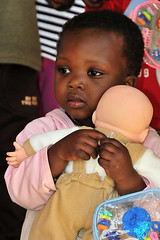
I read this story about Lucy Buck, a producer on Big Brother who gave up her job and her life and moved to Uganda to start an orphanage. After my recent trip, I understand that rationale.
Today, two years on, Lucy has not only set up her own children's charity, named the Child's I Foundation, but is about to open the doors of her own orphanage in Kampala. An incredible achievement for a girl who is just 32 years old.
With the help of a team of enthusiastic volunteers, she has transformed a once derelict house in a quiet suburb of bustling Kampala, the capital of Uganda.
Where once bricks were exposed and plaster was crumbling, now, bright jungle and underwater-themed murals cover the walls.
In just a few weeks time these newly-painted rooms will become home to Lucy's first tiny wards.
People’s biggest need, I think, is to feel purposeful. We want to feel as if we were created for a purpose, and as if we are living out that purpose. It goes along with our need for God. Without God there can’t be purpose; everything has to be random. You can recreate your life to make it meaningful anyway, as many without faith have attempted, but in the end we want to feel as if we are connected to something larger. We need to know that there is a greater plan than the one that we can see.
And there are days when I wonder if what I’m doing is really the best use of the 80-odd years I’ve been given on this earth (or however many I end up having). So many in history have risked all to live a big life, and I have to admit being very tempted towards that calling.
A few years ago our family made the decision to move to Kenya for the year. We had saved up money so we wouldn’t need to ask for support; we had found someone to live in our house; we had even found where Keith wanted to work. We had arranged work for me to do. And then doors kept closing in our faces. I won’t go into the details, but the final nail in the coffin was when our acceptance package arrived from the missions organization—and it had been burned to a crisp. It was in a plastic bag, in ashes, our address the only thing visible, with a note from the post office that someone had set the mailbox on fire, and this was all that was left.
It was our “burning bush” experience, except the thing burning was paper.
I surveyed a bunch of friends to ask them what they thought it meant. Was it more opposition that we were just supposed to overcome? Was it a sign that we weren’t to go? Or was it a sign that we were to persevere?
A very wise friend said to me, “If God wanted to get your attention, how else could he do it? Are you really saying to God, ‘could you just be a little more subtle?’” I decided he was right. We were already feeling as if things weren’t working out, so we said no. I was heartbroken, because I so wanted my kids to experience life overseas.
Then four months later the violence broke out after the election in Kenya, and houses were burned, and life was chaotic. We would have been smack in the middle of it, and I’m sure my mother-in-law would have had a heart attack watching the news. It was easy, in retrospect, to see why God didn’t want us to go that year.
And yet I feel as if our chance passed us by. Now that the girls are teens they are much more attached to our church, and to friends. It’s harder to leave for a year, and I don’t think we’d have their support in the way we did then. I do plan on going for an extended time, but it will be after they have grown.
Thus I am back here, questioning again the point of my life. I find myself so attracted to stories of people who have given up everything to live a more important dream. Not all of these people have moved overseas; some have simply taken in a bunch of foster kids; others have given up good jobs so that they could start an inner city ministry. I know one couple who felt so burdened by the plight of prostitutes that they gave up their jobs and started a ministry helping prostitutes find another way to support themselves and get off of the streets. They live in the red light district in Toronto; they have sacrificed much, and yet they see what effect their work is having.
I was thinking about the story of Esther lately. In that story, the king allowed Haman to issue an order to kill all the Jews, and Mordecai wanted Esther, the queen, to intervene. When Esther wrote to Mordecai saying she didn’t know if she could help because the king could kill her, Mordecai said something interesting. He wrote back:
Do not think that because you are in the king's house you alone of all the Jews will escape. For if you remain silent at this time, relief and deliverance from the Jews will arise from another place, but you and your father's family will perish. And who knows but that you have come to royal position for such a time as this? (Esther 4:12-14)
I love that. It is not that God NEEDS us. If we don’t help, He will simply raise up help elsewhere. But He does want to use us. If we don’t step up to the plate, someone else will, but we will miss the blessings. How many blessings are we missing because we're content with a small life?
I am not saying that we all need to do something dramatic to be in God’s will. He may be calling you to be just where you are. But at times I feel that’s a copout.
There are 12,000,000 street children in Africa, and countless more in Asia and South America. There are hundreds of thousands of children in foster care and up for adoption in our continent. Who should take care of these children, except for Christians? If the church as a whole stood up and did its job, we wouldn’t have a foster care crisis. We wouldn’t have older kids who are eligibile for adoption languishing in the system because nobody wants them.
And yet am I willing to disrupt my family life to take any in? I’m not sure. I need to talk more to God about it. But if I’m not willing, who is? Why do we always assume someone else will?
I am in awe of Mary Ostyn, whom I interviewed recently, who has adopted many orphans from overseas, as well as some from here. Her love flows. Does mine?
Perhaps I am drawn to the dramatic out of a bit of pride. When you do something dramatic, you can “prove” that you love God, that you are a good person, that you make a difference. When your life is less dramatic, all those things may be equally true, but they’re not as evident. Perhaps I just want to be one that other people look at and swoon over me.
But I don’t think so. At heart, I think I want to help, I just can’t figure out how to do it. This world has so many needs, and I don’t think I should just be confined to raising my own children—as important as that task is. So I will keep praying, and keep talking, and keep thinking, until I feel a peace. Or until I see something else burning.
About Me: I'm a Christian author of a bunch of books, and a frequent speaker to women's groups and marriage conferences. Best of all, I love homeschooling my daughters, Rebecca and Katie. And I love to knit. Preferably simultaneously.














![Reblog this post [with Zemanta]](http://img.zemanta.com/reblog_e.png?x-id=d22b3d6e-6a4b-4ecf-9fe1-4d09f2f6b896)


 Stumble It!


