When I first had my babies, I thought about what I wanted our family life to look like. And one of the first things on my list was laughter. I wanted our family to be a place where people laugh. I think love and laughter and memories all go together; it's difficult to have any of those things without also having the other. Does your home ring with laughter?
I read one study that teens laugh twice as much as adults in their fifties. And once we pass fifty, it's all downhill. We stop laughing. That's a tragedy. But perhaps we wouldn't stop if we fostered laughter in our homes! So here are some random thoughts on how to foster laughter, in no particular order:
1. Give kids permission to laugh at you.
This starts when they're toddlers. Whenever I did something stupid, I'd go running to wherever my kids were and I'd say, "Look how Mommy put my shirt on inside out!", or "Look how Mommy spilled!" And we'd all laugh. Children like to laugh. They like to feel that they can laugh at their parents, too, because while kids want to feel safe, they don't want to feel like their parents must be perfect. If you give your children the impression that they must always think you're perfect, then your children will feel disloyal and dishonest when they realize that you're NOT perfect. So give them safe ways to talk about your foibles!
And if Daddy does something funny, too, tell the kids about it, and laugh! Of course, you don't want to tease, and you certainly don't want to allow your children to tease each other. There is a difference between healthy laughter between people and laughing at someone, and you should teach your children the difference. But it will be easier to learn if you model it from the beginning!
2. Play a lot.
We laugh when we play. We laugh when we talk. We laugh when we're simply together and things happen. We don't tend to laugh when we're alone in our rooms doing our own thing. If you want to encourage laughter, you have to actually be together! And sometimes the things that you will end up laughing about are the things that you were absolutely upset about at the time.
I remember I once took my children camping, along with three of their friends. In one day I managed to break the tarp on our trailer, drench a child with water while trying to get the water off of said broken tarp, burn dinner, and then have the roof leak on us. At the time it was a tragedy because we had to leave camping early. But it's one of our funniest memories. In fact, those friends even drew a picture of all the things that went wrong, and it's still on our fridge, five years later. But we wouldn't have laughed about it if we hadn't been spending time together!
3. Do out of the ordinary things.
And when you do spend time together, do it in out of the ordinary ways! Don't just watch TV or movies, even if they are funny (though we still have a riot quoting Shrek). The things that are funny tend to be the things that happen in everyday life that you're paying attention enough to to see the humour in them. When you're trying to hurry up and get to all the practices or get dinner on the table you often don't have time to see the humour. So try to do strange things with your family!
Don't always watch TV; sometimes play board games, or go for walks, or play soccer in the park. Last spring the girls and I laughed for three weeks straight over "Fernando", a humongously obese baby robin that hung out on our fence posts because he couldn't fly. He would bleat all day and his much smaller mother would bring him worms. Every now and then Fernando would topple onto the ground and wobble down there for a bit. He was just a riot. They sometimes invited friends over to watch our pathetic robin. But we noticed him because we went for a walk; we didn't hibernate.
We also do really strange things at the dinner table. When the kids were younger, we'd have trivia questions after dinner. We'd ask Canadian trivia, and you couldn't leave the table until you got something right. My nephew, when he'd visit, would answer "Charlottetown" for every single question, and inevitably by question 12 or 13 he'd be right and he'd get to leave. It's been a running joke ever since.
A few years back I also purchased this little booklet of "graces you can sing" to the tune of hymns, and everytime we have company I pull them out. All the teens complain and moan and groan, but if they're ever over the first thing they'll ask is "are we going to sing grace?", because it's so strange and kinda funny, because most people don't know the tune.
Most of the humour in our lives isn't some side splitting joke; it's just everyday life that happens when we're alert enough to notice. So spend time together out of your regular errands, doing weird things, and you'll inevitably laugh!
4. Enforce technology free time
Finally, while movies and TV can be funny, and YouTube videos can make tears run down our faces sometimes, the best humour comes when we're just with each other. So have technology free nights, say from 6-8, where there is no TV or iPods or Facebook. Just spend time with each other, and you will laugh.
Sometimes we laugh just doing the dishes together--bubbles can be funny! Sometimes we laugh at memories while we're talking. Sometimes we laugh at my oldest daughter falling UP the stairs (I didn't know anyone could consistently fall UP the stairs until she hit puberty a few years back).
Having fun in your home means that other people will want to hang out with you. Your friends' kids will want to have dinner at your house. Your friends will enjoy being there. And so will your husband! A house filled with laughter is really a home, so don't drown it out by being too busy, too proper, or too plugged in!
My daughter Rebecca likes to tell the story of how sorry she felt for me the Christmas that she was 5. Rebecca opened her presents and received a whole bunch of "groovy girl" dolls from Mommy, and some Barbies from friends. But I didn't get any dolls. No one gave me Barbies. I had boring old blenders and books and some really nice pots. Rebecca wondered why no one gave me toys.
Children play. They play to learn, and to have fun. In some ways, a child's work is to play, because in playing they learn how the world works. They think about how relationships are supposed to work, how to build things, how to organize things. In playing they figure out life.
Animals do this, too. When they playfight, they're practising for real. They're learning valuable skills that they will need one day.
But there comes a time when the species does not need to play to learn anymore. We adults don't need dolls or Tonka trucks, though we may still collect them. We don't sit down on the floor with friends and act out a Barbie & Ken wedding, or set up house for some Polly Pockets, or create an obstacle course for our trucks. We put toys behind us.
It is not, however, because we no longer have fun. It is because other things have become fun.
What is the most fun you have? For me I suppose it depends how one defines fun. I enjoy knitting, and watching the occasional movie, and going for walks. I love playing board games with my family.
But I also find running our youth quizzing program really fun. I love poring over recipe books and coming up with a meal plan for the week. At times, when the urge hits (which I admit is not tremendously often), I even have great fun cleaning up the main floor of our house and purging tons of stuff. I find dropping loads off at thrift stores enormously fun.
I find blogging and speaking and building a little ministry fun, even if at times I have to drag myself out of bed to post for the day.
I find talking with my husband at the end of a long day fun.
The things I find fun, then, often include what people would normally call "work": meal planning, cleaning, building a business. But they're still fun because they're satisfying, and I feel great pride at having accomplished something.
Just as children's play is really "work" for them, and yet it's still fun, so our "work" can also be fun.
The problem is that our society does not understand that. We try to prolong this "play" period that children have, thinking that when the play is over, the fun is over. But we forget two things: play is also children's work, and adult work can also be fun! Children's play is not simply leisure; it's an essential part of what they must do in order to grow and become healthy, independent people. In the same way, when we do things that help us to become healthy, independent people, we will also tend to have fun.
But we won't have that fun if we're forever griping about the fact that we don't get to "play" anymore.
My post earlier this week about the appropriate end of childhood touched on some of these issues in the comments, but it boils down to this: While there should always be room for joy and laughter in a life, and work should never crowd those things out, we should never forget that much of the joy and laughter from life appropriately comes from things we normally think of as work.
As we get older, we stop wanting to play with Barbie's, and we start enjoying dreaming about new businesses to start; new ways to invest our money; new ways to decorate the living room; new crafts to try. These things are not play, but they can be very enjoyable because they combine our innate need for creative outlets, and our need for satisfaction from a job well done.
Work can be fun, if we understand fun to mean an intense feeling of satisfaction, and even a feeling of joy, as we become an active participant in God's plan for our lives. And what is that plan? To make the world reflect more of Him.
Think of it this way: God is creative. He loves beauty. He loves order. He loves people. As we do things that strengthen families, that bring more beauty to the world (even if it's just in a repainted kitchen), that cause others to smile or enjoy the beauty around them, we're bringing more of God into this world. And that is intensely satisfying.
Play always has a role in our lives, whether it's a church softball league or a family games night or Scrabble with Facebook friends. But adult fun is not limited to play. And, I would argue, adult fun is more intense when it isn't just about play, but is also about accomplishing something.
When we ask children to take more responsibility, then, or to start growing up, we're not saying, "the fun is over." Not at all. Instead, we're saying fun will now encompsas more of life. It won't just be about momentary pleasure; it will also be about heart-satisfying work. That's not something we have to apologize for kids for; it's something we should be making them look forward to!
As I have watched my own daughters grow into teenagers, I have seen that the things that they find fun often require effort. They study for Bible quizzing. They play the piano and the guitar, sometimes just sitting down to play and sing "for fun". They write, or create videos, or do a craft. They're not playing, but they still have fun, because fun is now so much bigger!
There is something magical about a child's make believe world, and we should not take that from them or force it to end prematurely. But we also should not try to extend "play" as long as possible, giving the impression that it's all downhill from here, because it's not. I have so much more fun now than I did as a child, and I hope the same for my children.
Let's redefine fun. It's not only about play; it's about finding satisfaction in meeting life's challenges and making this place a better world. Isn't that something to celebrate, rather than to mourn as the ending of childhood?
Last century, the biggest problem most families faced was money. How were they going to get food on the table? People were struggling to get by.
Today our problem is abundance. I don't necessarily mean abundance of money; I know many of you are hurting. But we have an abundance of everything: an abundance of choices about how to spend our time; an abundance of ads clamouring for us to buy something; an abundance of media squabbling among themselves for our attention; an abundance of activities that we should be doing at church, at school, at work.
And it leaves us exhausted.
Our society is running ragged. And because of that, we have lost the joy of the little things that families, even if they were struggling to eat, often shared in the last century. Read Huckleberry Finn or Tom Sawyer and you see the joy the boys made for themselves, without video games, without television, just with the great outdoors. Read Little House on the Prairie and you'll see a family of little girls making their own dolls and games, exploring nature, taking delight in reading new things, and loving to dance and sing.
When's the last time you sang as a family?
I don't mean to romanticize the nineteenth century, because it was not a uniformly good family time at all. Alcoholism was rampant, poverty was rampant, and all kinds of social ills often accompanied these things. But though we may have defeated some of their problems, we have replaced them with others of our own making. And many of us are sitting in the midst of a busy life, wondering how to climb out from under all the demands, all the laundry, all the chores, all the to-do lists.
I want to help. I've been feeling overwhelmed lately, as I often do in the fall when my year stretches before me, and I know all my speaking engagements are coming. If it were just real life, I think I could handle it, but it's my work life that impedes on my family life, and trying to find that balance is hard.
I know you're all in the same boat, though maybe for different reasons. You're stressed about money. You're stressed about your children's homework. You're stressed about how to maintain a marriage when your husband is unemployed or maybe he's working shift work. And I want to talk about it.
So for the month of October, I'm going to do a Simplify Your Life challenge. Every day I'll post a new post with some new ideas to simplify something specific in your life, whether it's laundry and menu planning or finding romance time with your spouse. We'll have some periodic challenges that you can participate in to win a prize, and I'll be recording a radio show to talk about it, too!
I'm introducing the whole concept on my BlogTalkRadio show this Thursday, at 12:00 EST. More here, where you can also sign up for a reminder to know when it's starting! And if you can't listen live, you can always listen after the fact to the recording!
Here's what I'd like you to do now for me: tell me the biggest source of stress and "busy-ness" in your life. I want to make sure I focus on the right things in October! So leave a comment, and share this on Facebook to let others know it's coming! Thanks so much!
On the wimp factor scale, I probably score near a "10" for wimpitude. I do not like pain, though I handled labour well enough because I knew it was coming and I may as well deal with it. But I don't like pain. I don't like exertion. And I don't like fear.
Teenage boys, on the other hand, seem to thrive on it.
Last year, my nephew was involved in the Bible quizzing program at our church, and he reached a milestone for verses memorized, so we let him name his prize. He wanted to go paintballing. My husband said he'd take him. But Alex didn't just want my husband Keith. He wanted me, too.
I initially put him off, but finally yesterday I assented. I think we often "pooh pooh" teenagers and don't spend enough time with them on their own terms because they want to do things we don't like. But if we want teens to see us as approachable, and to respect our opinions, we have to come down to their level, too. It has to go both ways. We can't expect them to want to be with us and to listen to our advice if we don't also occasionally go out of our way to affirm their interests.
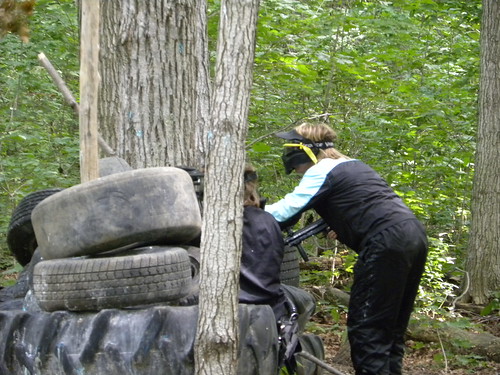
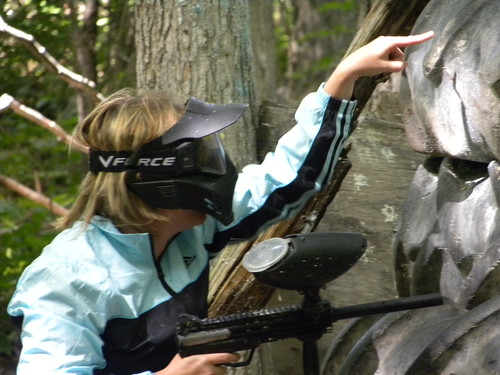
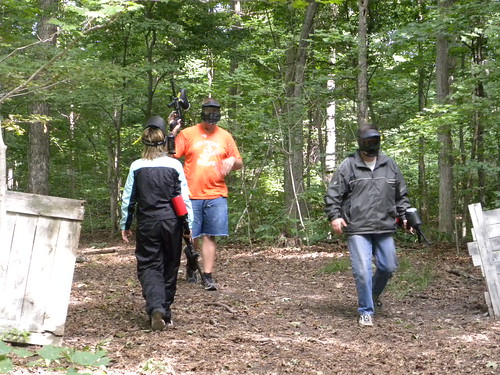
So today I took a deep breath, loaded up on padded clothing (despite the heat), and went paintballing. My daughter did not. She just kept the camera.
My husband, three teenage boys, and me. Quite the sight. I had on a knit top and a knit sweater (knit is far more absorbent of impact) and a jogging outfit over the whole thing. And for those of you who think Canada is never hot, you're wrong! It was in the mid-80s today. But I need padding, even if it makes me sweat like a pig.
Now I know some of you reading this won't approve of paintballing because of the guns. I understand the sentiment. But for me it wasn't really about the guns as much as it was about bonding with the kids. And let's face it: he's going to go paintballing with or without me, and he's going to play violent video games. I'd rather he go paintballing and have a social afternoon than play video games. And he's planning on going into the military, anyway, which I think is a noble profession, so I'm not opposed to the practice. If you are, please forgive me, and realize the spirit in which I was partaking.
For the first round I was too scared to move. I had a whole new respect for soldiers, realizing how difficult it must be to run with bullets flying. For the second round I ventured out a bit, and by the fifth round I managed to just nail my husband in the back, which I sheepishly admit was a little bit too satisfying! Alex managed to hit me twice, and it didn't hurt nearly as much as I thought it would.
Looking like I'm doing something:
Trees are my new best friend:
I love walls, too:
If I make a run for it, can I make it out of here?
He's over there:
Hubby after he's hit:
All done!
Will I go again? I suppose I probably will, because the teenage guys in our church do like it, and they'll be helping me out with coaching our quizzing teams this year. It seems like a reward they'd appreciate, and I do like spending time with them. Unfortunately, I don't think they'll take up knitting!
Some of us are. We're not comfortable with plans. We want to leave life open to possibilities. We want to be open to God, not put constraints on Him, and just let life happen!
I think that attitude definitely has positive aspects. I know there are times in my life when I need to learn to go with the flow more and I need to stop trying to control everything. Sometimes things just aren't working, and we need to throw up our arms in exasperation and head to Dairy Queen.
I've done that on some homeschooling days, when nobody is getting anything done, everybody is sniping at everybody else, and it's better just to call it a day. So we head out on an impromptu field trip, or we decide to scrap the books and curl up under a blanket to watch a Jane Austen movie.
Sometimes you need to go with the flow at other times. You have your week planned ahead of you, and a friend calls. Her little boy has had an accident, and she has to be at the hospital with him. Can you take her two little girls? You can't say no, but there go all of your plans. Rather than stressing about it, it's better just to realize that your plans are toast, and embrace your new reality! Otherwise you'll just end up grumpy at everybody.
But even though we need to go with the flow at times, and even though we need to open to God's Spirit, I don't think this lackadaisical attitude towards life is the best one. Most of life has to be intentional. When we are not intentional about where we are going, or why we are going there, we're going to end up going nowhere, and then wonder why.
I mentioned in my column last Friday that nobody ever drifts together; they only ever drift apart.Many people are living their lives without really being intentional. They're raising their kids, but they don't have a good idea what they're raising them for. They believe in God, but they haven't ever thought through how they're going to pass on that belief to their children. They want a good marriage, but they haven't though through what that entails.
And until we do, we won't be effective. You can have all the emotional and spiritual resources in the world to make your family strong, but unless you sit down and intentionally use those resources, your family won't benefit.
Too many things pull us apart: time, technology, jobs, responsibilities. Very few pull us together. I know so many families who let their teens work so hard at part-time jobs that they don't have time for youth group or church. Those kids are making all their friends at school, but don't really have a Christian peer group. Or then there are the dads who are super-involved at church and super-involved in their work, and they figure that their kids will somehow pick up their faith by osmosis, even though they take no time to talk to their kids or mentor their kids or even play with their kids.
One of the best ways to counter the drift that so often happens in our lives is long term planning. I have two friends, a husband and wife team, who spend much of August strategically planning for their family. They ask themselves:
1. Where do we want to be in five years? 2. Where do we want to be in two years? 3. Where do we want to be in one year?
And then they figure out how to get there! And over the last few years, as their daughters have grown and they've realized that their time as a family is short before everyone grows up and moves on, they've made it a priority to spend more time as a family. They've gone on medical missions trips together. They've taken vacations. They've deliberately done things, even in the midst of their busy lives, because they had to.
This family lives in a small town where large churches with mega resources for great youth groups don't exist. They've had to create a youth group out of the kids' friends, and make sure that they have a good set of peers who are being discipled. They've had to take the responsibility for their kids' Christian education, because it wasn't happening at their church.
And in the meantime, they've made sure that their children learned some job skills and other skills they would need when they left home. But they did it by taking August to plan.
They mapped out their vacation schedules, months in advance. They are both professionals (they're both doctors), so they've figured out what conferences they would go to that year based on whether the kids could go and whether it could be a family activity. They've scheduled in the kids' stuff.
And they've decided what extra-curricular activities they were going to do, and when. If they saw a certain month was getting busy for work, they deliberately planned some romantic nights and weekends the month before and the month after.
And they prayed. They brought their multi-coloured highlighters, their full sized calendars, and their Bibles and journals, and they spent a weekend praying through their year.
It's a great idea, because when you don't, life happens, and you drift along with the current. You don't realize that you don't actually want to be swimming in that direction.
When your child comes to you in September and announces he wants to take karate, you can't think of a good reason to say no, so you sign him up. But you don't realize that lessons are Thursday nights, and Thursday is the only night all of you have free during November and December, so that was supposed to be your family games' night. If you had planned, you would have known that.
I find men often appreciate a bit of strategic planning because it's already how they think. They like having things mapped out, perhaps more than we do. They like knowing where they're going. And if you can turn it into a romantic getaway with multi-coloured highlighters, more power to you!
I have found more and more that time is sneaking up on me, and I have to be intentional about what we're doing as a family. So this August, Keith and I are taking off for a four-day trip to be together and to pray through this year, while doing a bunch of biking, too. Don't let the summer go by without thinking about what you really want your next year to look like. Take some time and pray and plan with your honey. Make it fun for him, too. Ask the important questions. And then you're far less likely to feel swept away by tides you can't control.
My husband comes from a very competitive family. I love playing cards with them, but as a child Keith remembers a lot of tension around games, so he stopped playing after a while. My mother experienced something similar. Sometimes people are such sore losers, and take winning and losing so seriously, that it wrecks it for other people (and can even be quite disruptive).
I read a post recently by a mom who is worried that her son is getting too caught up in winning. The mom reports:
My almost 7yo boy likes to play games. However, if he makes a wrong move, answers wrong, or loses the game, his face is immediately red and the dam breaks with floods of tears. He is an only child, so no siblings to help him with this.
I’ve tried lately to play more games with him to work on his attitude but I am at a loss. We’ve talked about winning, losing and having fun playing the game, it’s okay to want to win, but it’s important to be gracious whether you win or lose, etc. etc. – but nothing works. His personality is dramatic and emotional “I can’t believe I missed that!”. Human pride at its peak. He bounces back quickly, apologizes and wants to play another game – but I’m at my wit’s end.
So what does she do?
Personally, I wouldn't make an overly big deal out of it yet. He's 7, and part of being young is learning how to (a) identify your emotions and (b) deal with your emotions. Many people are competitive, and that, in and of itself, is not a bad thing. Apparently boys who are competitive tend to do much better in school, and schools that encourage competitiveness tend to bring out the best in boys. Especially with males, it's often wired that way!
The problem, as this mom has identified, comes when they start judging themselves in terms of "works", or start feeling proud of themselves for it. Here's a way out, for those of you who are having the same problem!
1. Praise effort. After playing a game, I would reinforce what you know is true about your son, and reward him for TRYING, not just for accomplishing. In your house, keep the language of trying more positive than the language of winning. So say "congratulations for putting in such an effort". We do that in our homeschool, too. If they try at math, but don't do well, they get praised much more than if it was an easy lesson they breezed through.
Do this in every area of your child's life. It's effort that counts. To God, the heart matters, and then He's the one who brings the fruit, not us. So we should never take credit for our successes, but only for the effort we put into it. Try to do the same thing with your child!
2. Keep talking about how God sees your child. Just keep talking about how God sees us. I wouldn't lecture him at 7 on the psychology of winning, because I don't think kids that age get it. I would, however, surround him with truth. Tell your children that God made them for a purpose. Tell them that they are the way they are for a reason. Tell them that God put them together in exactly that way because they are perfectly made for what He has planned. Not everyone has to win at everything. But even those who are amazing card players or basketball players or Monopoly players lose at life if they don't live out God's plan. That's what counts. Talk about that all the time, and as your children grow up, they'll get it!
When they're teenagers this often hits even harder. Kids who don't feel good at things get very despondent. They don't see what they're worth. Fill your home with stories of ordinary people that God used simply because they were willing. Talk about how what matters is not ability as much as willingness and obedience. The world is full of talented people who have made a mess out of their lives. Mother Theresa wasn't particularly talented at anything. She just made herself available. Praise these things.
And for that reason, don't make sports a huge deal in your home. If your husband is a sports fanatic, I suppose that's okay (though I don't understand it :). But remember that sports can reinforce the wrong message. Our heroes are not athletes; our heroes should be those who use what God has given them (athletes can do this, of course, but that's not usually what we pride in them).
3. Teach your child to handle disappointment. Many children have really violent emotions. It hits them so hard they scream, or pick up the board and fling it across the room. It's not that they're bad; it's that the feeling is so overwhelming they don't know what to do with that. They're born with anger issues.
Part of your job as a parent is to teach the child to identify when they're entering into these angry phases so that they can stop the process before it gets going. Say to him or her, "You look like you're angry. Time to go kick the soccer ball around!" Give them an active way to blow off steam. But do identify the emotion, so that they can put a name to it (when I feel this way, I'm angry). It helps later on in life. So teach your child how to redirect those feelings.
I wouldn't punish a child for acting out when they lose. I'd try these things first. Remember that a child is not an adult. They don't yet know how to handle these strange emotions. And emotions, in and of themselves, are not bad. It's what they do with them that matters. So teach them not to sulk and not to become violent. Teach them instead truth about who they are. Reward effort, not achievement. And teach them to redirect negative feelings.
And you just may find that you enjoy playing games as a family much more!
Has anyone in your family had issues with anger? Anyone a sore loser? How did you deal with it?
I'm trying to post quick intimacy tips on Fridays, when I remember, to inspire you all to pucker up before the weekend!
So here's this weekend's challenge: gross your kids out! That's right: kiss in front of them, hug in front of them, pat your hubby on the behind! Make your kids moan in agony. They secretly love it, anyway. I know my nieces and nephews, who have parents who are divorced, actually like to see Keith and me hug and kiss!
My youngest daughter always says, "EEEwwwwwww!", but then she stands there and watches. They like to see their parents kiss. So tonight, when your hubby gets home, greet him at the door and lay a big one on him, with the kids right there. And tell the kids how much you like kissing Daddy. It'll make him feel like a million bucks!
Want more intimacy tips on how to get in the mood? Listen to Sheila's audio download, Honey, I Don't Have a Headache Tonight! Filled with lots of laughs and practical tips to boost your marriage! Download it now!
As a child I loved board games. I dissected Monopoly, trying to find the best strategy. I taught myself chess from a book. I loved Sorry, and Life, and eventually Trivial Pursuit when it came out. But the problem was that I didn't have anyone to play with. As an only child, I used to try to play them myself, being two or three different people at a time.
My mother and step-father played with me occasionally, but it's hard as an only child, trying to amuse yourself. Maybe that's why as an adult I have made such an effort to have family games nights with my kids.
When children are little, games are hard because, quite frankly, most kids' games are boring. I could only take Candyland for so long. But as they grow, you can start playing REAL games. Before real games were possible in our house, we often put puzzles together, because that can be fun for the whole family, and at least it's a little challenging for you! Have the kids work on the edge pieces or the pattern pieces while you work on the hard clouds or something.
But now we do games. And not just typical ones, either. If you want the best games, you need to go to a specialty game or toy store. Wal-Mart just doesn't have all the good ones. Some of our favourites are Bohnanza, a card type game that even 7-year-olds can play, but we still play with only adults; Carcassone; Blokus ; The Settlers of Catan; and Ticket to Ride. They're really fun!
Last weekend we visited our former pastor who now heads up another church. He asked my husband and I to come and give the sermon on communication in marriage, and it was a ton of fun. Afterwards we relaxed at their house, talking for a few hours before making the trek home.
And we started talking about communication in families. I made the point that many kids no longer know how to be friends because they spend their lives texting each other rather than talking to each other. The other couple wasn't sure that was the case, since their kids text all the time but are still very socially aware. "But you guys eat together every single night!" I said. "Do you know how rare that is?"
And it's true. Children tend to learn communication skills from sitting and eating at the table. You can then expand that time to build real family memories by making one night of the week a games night, where technology stays off and everybody tries to be home. Some families do family movie nights, which can also be fun, but I strongly recommend a games night, because when you're watching a movie, you don't talk. When you're playing a game, you do.
My husband wasn't the biggest fan of games nights growing up, because his family was very competitive, and he didn't like the stress. As much as possible, try to minimize too much stress for your kids who can't handle it, but I do think it's good to learn to lose. Last night my 12 year old could not get good cards to save her life. Usually she plays very well, but it didn't work out for her yesterday. Yes, she was frustrated, but she still laughed a lot, and it was so much fun to connect.
I know it can be hard to have a games night with older children while you still have younger ones, but you can take turns entertaining the baby or the toddler, or set up special toys they have just for that time when the rest of you play a game. But do have a special night, every week if you can, when you eat together and play games. Family routine matters, and if you decide to make it a routine, it will get done. And then your kids will remember the togetherness, they'll remember the laughter, and they will feel much more connected to you and to each other!
Now you tell me: what games do you enjoy as a family? What works well with little children? What did you like growing up? We want to know!
Today I'm talking TV, both on Works for me Wednesday and Wifey Wednesday! And I need to tell you, one of the best things we ever did as a family was cancel cable.
We did it about twelve years ago, when the children were very young. I used to watch TV non-stop during the day, just to have noise on. I still played with the girls, but the TV was always there.
Then one Thursday night I realized that I was depressed again. And I was always depressed on Thursdays. Tracing it back, I realized it was because I watched ER, which was a very depressing show! And I decided that I didn't need that in my life anymore. So the TV was gone.
And because of that, my children weren't exposed to inappropriate things too early. They know how to play by themselves. They used to make up games. They read a ton.
It isn't that we're total saints. We subscribe to the Canadian version of netflix, so we do watch DVDs. But we're very picky about what we watch, and so we're not watching just anything because it's on, like I used to. You don't even miss TV shows that way, because the good ones come out on DVD a year later anyway. We're catching up on Heroes right now, which is quite good in its first season. But we don't watch TV all night. Just for an hour a few nights a week, after the kids go to bed. And they hardly watch any at all.
I mentioned all of this in a syndicated column recently, and then got into an email conversation with Deanna Grove, who runs The Garden Place in Frankford, near my home. She writes this:
As a side thought, I also don't believe the excuse some people may use that it's cheap entertainment. I wonder what would happen if we challenged parents to try leaving the t.v. off for one whole week? I can guess that a typical family would be wondering around the hallways after supper like lost souls...for a couple of days. But then I think they'd find far more interesting and productive things to do. And, hey, they might actually get around to doing things they've wanted to do for a long time, but never had the time to do it! It may be a little more difficult for teenagers, though, with their peer pressures.
I was thinking about what she said, and it reminded me of meeting Gordon Korman when I was 13. He was 18 at the time, and had several best selling youth novels under his belt. He wrote his first at 13. It was a school project his teacher recommended he expand upon. And since then he's written dozens of novels.
But imagine: being a published author at 13. You can do that when you're not wasting your time on television.
It's hard to quit, I know. I did it. You're sure to get resistance from your family. But I tell you, it was the best decision we ever made. Even if all you do is keep TV for weekends, so that the kids have to save up for it, or only let them watch one show a week, that they pick in advance, that's better. But the problem is that TV isn't only bad for the kids; it's bad for the adults. It keeps us from doing more productive things.
Let me leave you with something else Deanna wrote, as she details her journey to give up television (remember Deanna owns a garden shop):
John and I live in Frankford, and after reading your column on "television watching," I just had to let you know how much we agree with you and what steps we've taken to realize what a waste of time (sorry to be so blunt) watching t.v. is/was.
A few years ago, before moving from Mississauga to Frankford, we questioned the amount of "useful" t.v. we watched and up until then subscribed to many stations. Because we spent from April to October outside (partly because we love being outside and partly because of our business - please help yourself to our website) we didn't even turn on the t.v. during those months at all. So, we "downsized" the channels. We didn't miss the extra channels one bit. Then when we moved here in 2007, our cable options were non-existent and again, we questioned whether we were interested in watching t.v. The answer was an honest "no." So, for 2 years, we haven't watched t.v. Do we miss it? Well, we get all our news whenever we feel like it from the internet, are more in tune with our community, because we have more time to do so, thanks to organizations such as the Quinte West Chamber of Commerce, and occasionally purchase good movies for entertainment in the winter. We have time to read books and be together. The house is actually clean (in the winter), we enjoy cooking and having friends over - in an unstressed manner - and (here's the real kicker) are less annoyed. Yes, "annoyed." We get tons of extra jobs done in the house that we never had time for before and are happier people. Of course, to be fair, we have also changed our lives from living in the big city with 9 to 5 office jobs, to living in the country, and are following our passion - designing and creating gardens. Once in a while we pop round to our friends' house to watch a hockey game and/or doggy-sit. And when we put the t.v. on, can't believe the useless entertainment with commercials inserted every 7 minutes or so intruding on our precious time. So, the answer is a great, big "NO." I doubt we'll ever hook up our t.v. now. We both think that most television programs are useless, uninformative, fake, annoying, loud, an insult to our intelligence, transparent, did I mention annoying, and such a waste of time!
So, in answer to your question in your column "...leave that infernal screen behind, are you with me?..." Our answer is "YES!!!" And now, I'll stop being a hypocrite and get off the "checking my emails" computer, and get outside while the sunshine and birds and fresh air are calling us. These are the important things to us.
And they're important to me, too. So if you've been feeling the urge to cut down on TV, here's a roadmap to help:
1. Post sign-up sheets on the fridge where people can sign up with what TV shows they want to watch that week.
2. Make them earn TV by spending time outside/in active play.
3. Post a list of at least 20 ideas on the fridge of things to do instead of television, so that if anyone says "I'm bored", you can send them to that list.
4. Invest in some fun board games, and start a family games night at least once a week after dinner.
5. Move the TV to the basement, to an out of the way place, so it's not staring at you in the living room all the time.
6. Set up the furniture in the family room so that instead of being oriented towards the television, it's oriented towards playing games.
7. Pray!
Good luck, and may you beat the TV habit, too!
Thanks for visiting! Do stay around a while! I've got a ton of posts on marriage, motherhood, and more!
Every Friday my syndicated column appears in a variety of newspapers across Canada, and this week's builds on a blog post I had earlier this week complaining about my busy-ness. See if you can relate:
I’ve been a little panicky lately with all the stuff on my plate, and as Christmas approaches it’s only going to get worse. As I’ve been weighing the option of having a full-fledged panic attack to extricate myself from some commitments, I started thinking about the basic assumption of busy-ness. It goes like this: we have too much to do, and not enough time to do it in. In other words, there are two sides of the scale: how much is on our plate, and then how big that plate is.
Let’s look at how much is on our plate. According to time studies, we don’t actually have that much more work to do today than we did thirty years ago. We’re slightly more burdened, but it’s not catastrophic by any stretch of the imagination. So what’s up?
Certainly it could be that we’re spending too much time in extracurricular activities and in volunteer work. Many of our children are over-scheduled, and I do think we need to re-evaluate how much we’re willing to be out of the house over the things that aren’t absolutely necessary. But that’s a subject for a different column.
What I’m really interested in is this idea of how big our plate is. What if we’re not actually busier, but we just feel busier?
If we have roughly the same amount of leisure time as our parents did, and even more than our grandparents did, then what is our major malfunction? Perhaps the problem is not how much we have to do, but instead how we’re spending the time at our disposal. For instance, when we choose to spend our leisure time in front of a screen, we often lose a significant portion of our day.
When you sit down at the TV, do you think to yourself, “I'll just sit here for two and a half hours?” Chances are you don't, but often you find it sucks you in anyway. Most Canadians spend over thirty hours a week in front of a screen. That’s a lot of potential time eaten up right there. My weakness is the internet. I sit down to "check a few emails" and suddenly two hours have evaporated.
I wonder, then, how much of our busy-ness simply stems from the crazy ways we spend our leisure time. Often we turn to time wasters, like TV and the internet, because we're tired, and we just want to relax. Unfortunately, these things don’t necessarily relax us, and we end up worse than we were before. Researchers have shown that watching violent movies or television shows, or watching dysfunctional families on reality shows, actually makes our mood worse, not better.
What really relaxes me is playing games with my kids, knitting, or bubble baths. If I don't have time to knit because I've been on the internet for two hours, I don't feel relaxed, even though I've had what looks like all this “me” time. If I spend a half hour exercising, and then a half hour with my kids, and then an hour in the bubble bath, though, chances are I would feel a lot better than I do after surfing the web.
Perhaps the reason that we feel so busy isn't that we're actually busy as much as it is that we’re realizing the important things aren't getting done. If we prioritized those important things, a lot of stress would dissipate. We'd go to bed at night knowing that we had had a good day. I'd really like that feeling again, so rather than having a panic attack over my busy-ness, I think I’ll just try to leave that infernal screen behind. Are you with me?
Don't miss a Reality Check! Sign up to receive my weekly column FREE in your inbox.
This is a continuation to my Saturday post, which was a continuation to my Thursday post! So you may want to scroll down and read those first. But here's the basic problem I'm looking at: do we as parents sign our children up for too many activities, and does that have a toll on our family time? I believe it does, and I laid it out on Saturday that the average family with school aged kids has, at maximum, 19 hours a week of potential quality time. That's not much. And that's before they do any lessons. Take skating for 8 hours a week and you're down to 11. Not a pretty picture.
But let's take this one step further. I believe that with parenting it is so important to keep the long-term goal in mind. We talked on Saturday about what those goals for our children should be. Let's focus today on one specific one, and one very general one. First, the specific: we want our kids to develop fitness habits. After all, one of the reasons that we put our kids in sports lessons is so that they can stay fit! We live in a very sedentary society, and we need to encourage all the exercise we can, right?
I'm not so sure. I took ballet a ton as a child. Two nights a week when I was 13 and 14, one night a week from 6-13. I actually was quite good. And you know what? I can't do any of it now. I took adult ballet lessons when I was 30 for fun, and wrecked my knee because I tried to do the "turn-out" as much as I did at 14, and found my body no longer cooperated. Ballet isn't the type of thing you can just keep doing. It doesn't keep you fit. Sure it keeps you fit then, and it does help your posture (and it taught me to suck my stomach in, which I still do today), but you can't keep it up. There's no natural place "just to do ballet" in your life. So it doesn't encourage long-term fitness.
What about sports? Hockey and soccer are almost the same. Some men are involved in leagues as adults, as are fewer women, but it's not widely done as an adult. So you can't rely on those things to keep you fit. You may love them, but if you're only playing hockey as an adult once a week over the course of four months, it isn't going to cut it.
Skating or gymnastics? Don't even get me started. Those aren't going to keep you fit as an adult, either.
There's really only one sport that I can see that does have the potential to keep you fit, and that would be swimming. (And, of course, track and field, but few children do this as an extracurricular activity.) So you may have your child in some sport for 5-10 hours a week, and that sport will do diddly squat for them when they are adults. It isn't going to encourage fitness. It's simply going to keep them fit right now. There is some benefit to that, of course, and those kids who like being fit are more likely to adopt other fitness activities, but the sport itself won't do much.
If you really want your children to be fit, they need to develop habits that they can continue easily as an adult. And what are such habits? Biking. Walking. Playing soccer and frisbee and touch football with family. Working out at the Y together (if they have kids' programs). Swimming together. Cross-country skiing. Jogging. As kids get older, these are all things you can do with them, which will keep you fit, too. They contribute to family time, they don't take away from it. And they're more likely to meet your goals of raising a child who is healthy than putting that child into hockey 10 hours a week. Even more importantly, if your child is in extracurricular activities multiple nights a week, you won't have time to develop these activities as a family. So they won't get done.
Now let's look at something more general. I believe that children who are most likely to adopt their parents' value systems are those children who most identify with their parents and their family as the primary influence in their lives. They're kids who enjoy their parents, enjoy their family, and want to remain close. Kids who primarily identify with peers do not tend to adopt their parents' value systems, as Judith Harris' book The Nurther Assumption showed.
How, then, do you get kids to identify with the family? You have fun. You hang out. You spend time together. You make the default in their lives "being with the family". So many times kids are in so many activities that their primary relationships aren't even with siblings anymore. And if you stop identifying with your siblings or your parents to such a great extent, it's unlikely that "family" will be considered your first priority.
You can't just have fun on a schedule. You need downtime for that. You need time for people to laugh, and be themselves. You need time for siblings to decide that spending time together is actually worth it. Often kids need to get bored before they will do something together, but if everything is hyper scheduled, they're never bored, and they don't turn to each other.
There's nothing wrong with boredom. It's the birthplace of many a great idea or great game. Kids get bored, so they need to find something to do. That's when they reach out to little, bratty brothers or sisters. That's when they make up games. That's when they use their imagination.
Let's stop giving our kids deliberately to a schedule which denies them so much family time. They may enjoy it at the time, but in the long run, what is the most important goal for your family? Some families may be able to squeeze everything in, and more power to you! But I have seen families who have thought they were doing it well, only to find fifteen years later that their kids weren't following God and weren't overly involved with their families. It's a big risk. It may be one you want to take, because your child is gifted or really wants to do something. Just realize it's a risk. Count the cost first, so that you can be sure that you are doing everything you can to preserve your family life in the time you have left. But I hope most of you may choose just to hang out at home and maybe, occasionally, throw a football around together. I think, in the long run, that may be more valuable.
I have a daughter who is very talented at figure skating. She pretty much taught herself, watching YouTube videos of famous skaters and then practising during our homeschool skate times.
We've been trying to put her in lessons, but the clubs near us are always full. I'm going to make the effort next year, though, because she is very committed to it.
When she was younger she had the opportunity to do competitive gymnastics. She's always been really flexible; she often sits in the splits while she reads.
And we said no anyway. My cousin was in competitive, and she had a great time, but it's not that she ever got to the Olympics or anything. And so she spent 15 hours a week doing a hobby that made her parents rush her around everywhere. I'm not saying my aunt and uncle were wrong; I don't think they were. It's just that for our family I didn't want that. And maybe I could have handled the lessons during the week, but the kicker for me was the summer. They expected you to be there for 75% of the lesson times anyway, and we like to go camping and get away in the summer. I just couldn't give that up.
I think children should have the chance to do well at sports, and pursue hobbies and dreams. But too often today these things take on a seriousness which I don't think they warrant.
I was browsing some blogs lately, and I came across one woman at the United States of Motherhood who was bemoaning her child's competitive swimming. He had actually made it into the top 38 in the nation, and so he was on his way. But listen to their schedule:
He loves swimming. His friends and social circle are there. It's his thing. But he used to love to read? He used to get great grades? Where did that boy go? .... Was I wrong? Am I wrong to let swimming take over our life?
Swimming seven days a week. Some days we leave for swimming at 3:30 and get home at 9 PM.
Dinner is eaten on the run most nights.
Homework is done in the car, in the stands of the pool, or at the nearby library.
She ended up threatening to take away swimming this summer because of his grades, which is a worry. But I think there's a bigger worry. Here's my take, and what I would say to her:
When your son is older, what will ultimately matter is not swimming lessons or swim team, as beneficial as that may be. What will matter is that he has a strong relationship with you which grounded him in his identity, his faith, his integrity, and his character.
Swimming is fun, but it is not the main thing in life. The main thing is your character and what you will become. Swimming can play a role in teaching discipline, but what he really needs is to anchored in his family, and for that you need time to be a family--to eat dinner together, to play together, to walk together.
Seven days a week is just too much, even if he's Olympic material. The Olympics are not worth sacrificing your family over.
So you need to find balance. The thing that is most correlated with academic, relational, and emotional success in life is eating dinner as a family. If you have no time, that's a problem.
I look at some of these girls who have won Olympic medals in gymnastics or skating, and I still think it wasn't worth it. So they've got a medal. They've wrecked their childhood. And it's your relationship and stability with your family that you only get during those childhood years that helps them form the morals and values, and acquire the faith, they need later in life.
I know that sports teaches you morals, but it can't replace a family just hanging out together.
So my advice to you this summer: don't overschedule it. Now's the time to quit a lot of outside involvement. Hang out together. Escape together. Talk together. Read together. Be together again without having to nag about homework, or piano practice, or getting to bed early. This is your chance just to have fun and rediscover family. Don't waste it!
About Me: I'm a Christian author of a bunch of books, and a frequent speaker to women's groups and marriage conferences. Best of all, I love homeschooling my daughters, Rebecca and Katie. And I love to knit. Preferably simultaneously.
















 Stumble It!











![Reblog this post [with Zemanta]](http://img.zemanta.com/reblog_e.png?x-id=3b00723e-f1f1-4358-a00d-c9635552489f)


![Reblog this post [with Zemanta]](http://img.zemanta.com/reblog_e.png?x-id=81849a7f-7437-4ed9-93c8-89af94dc8a48)

 , a card type game that even 7-year-olds can play, but we still play with only adults; Carcassone;
  ;
;  ; and
; and ![Reblog this post [with Zemanta]](http://img.zemanta.com/reblog_e.png?x-id=23158b6e-0df2-4080-ae4e-77b672fa171f)


